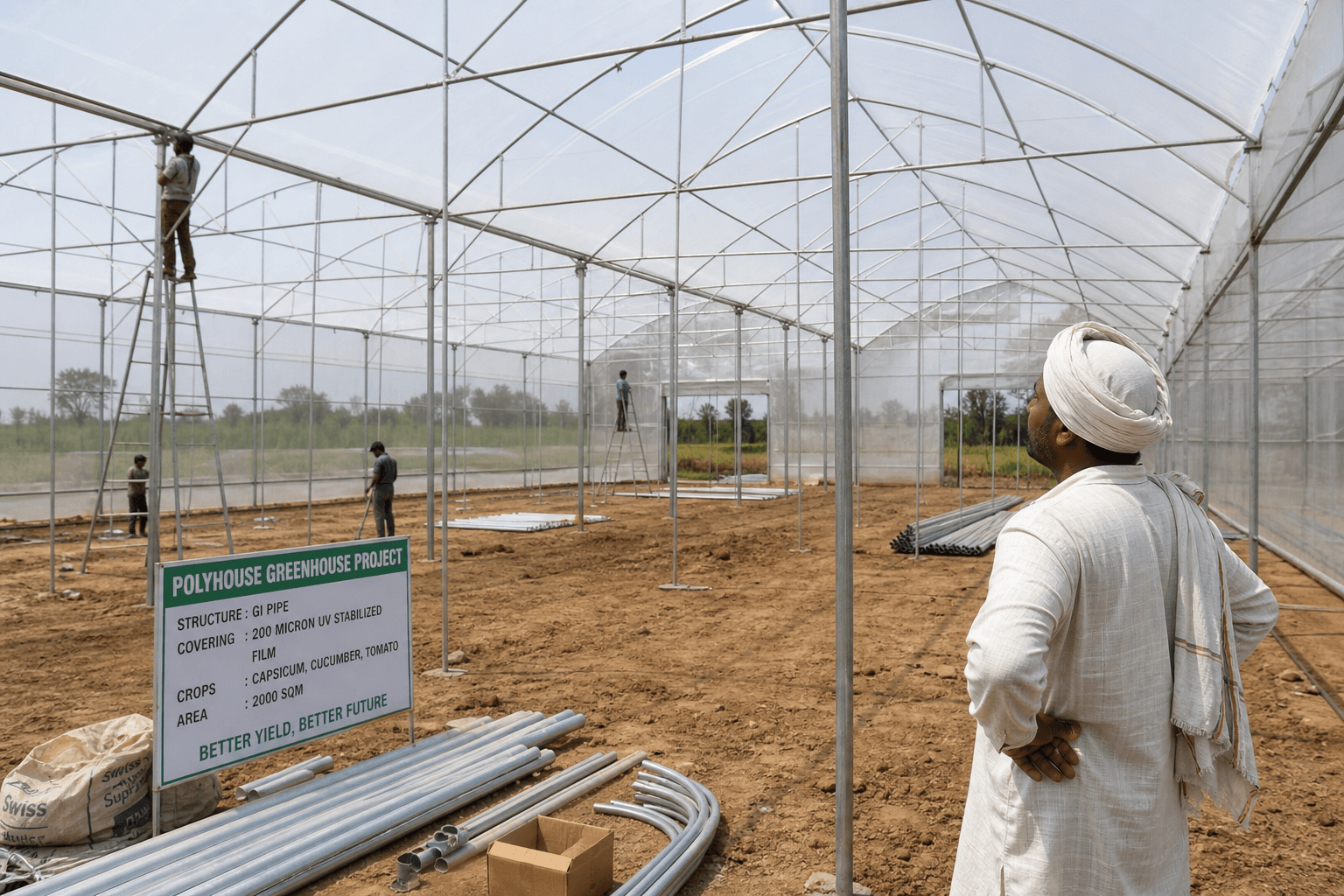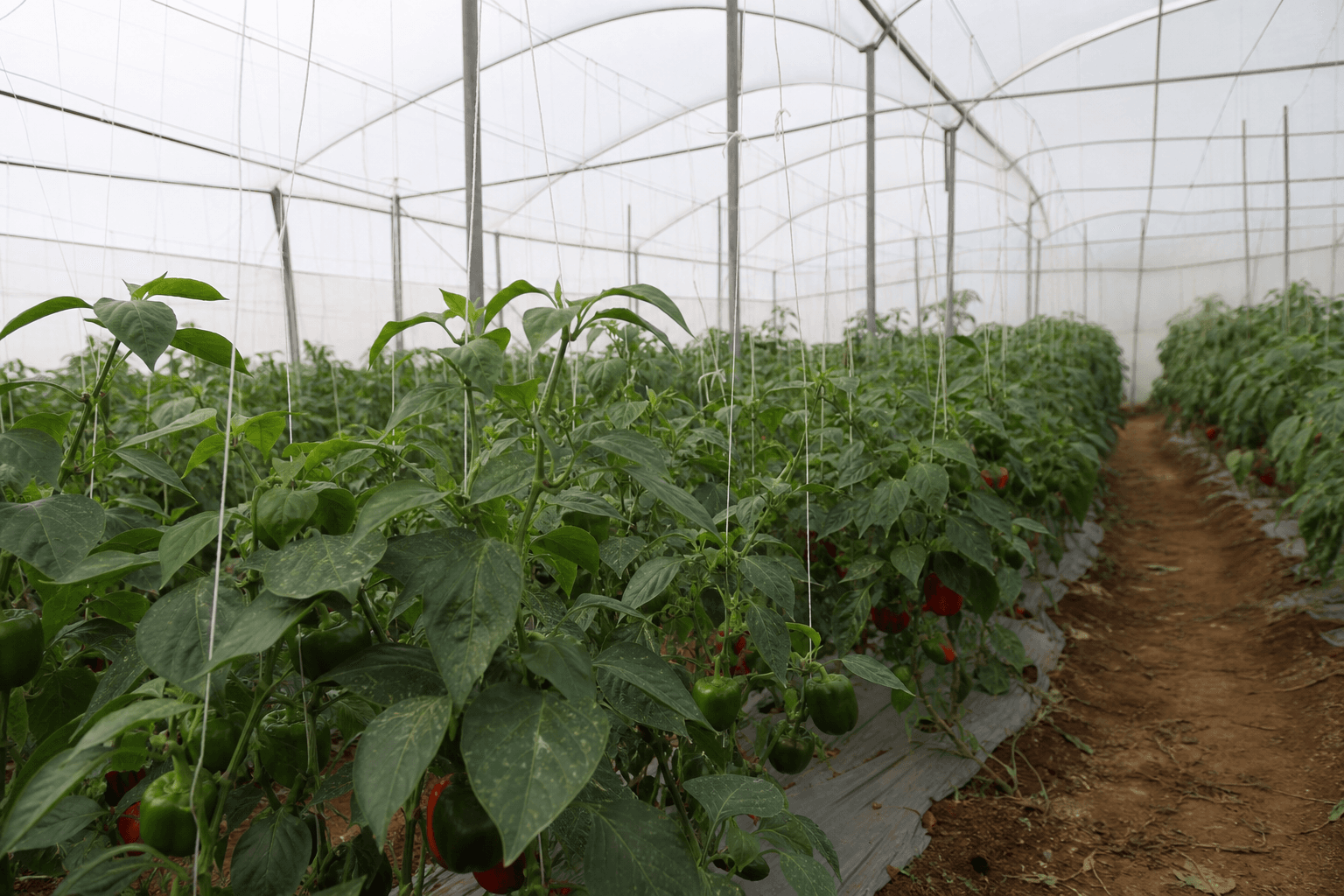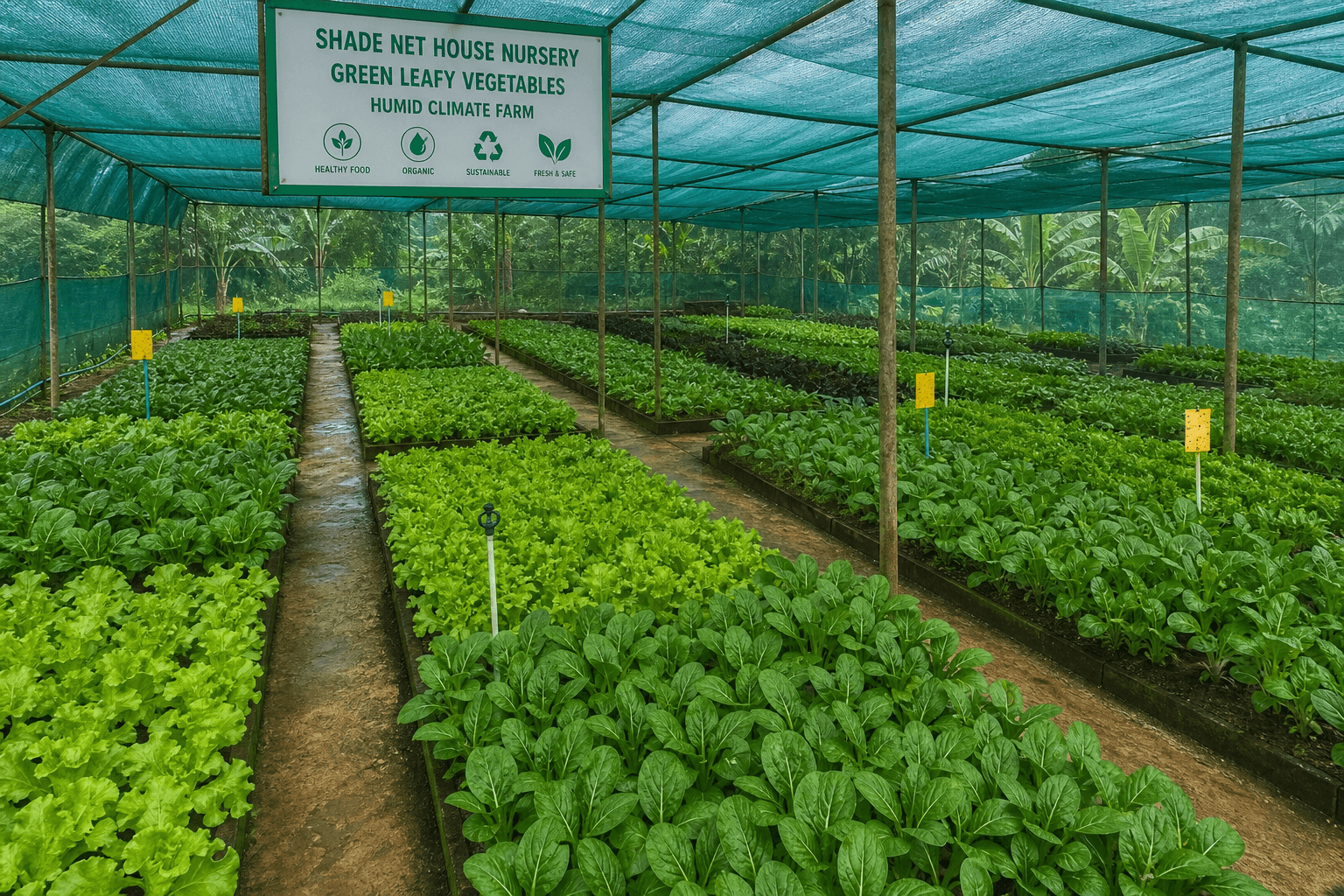
Shade net house farming is the most affordable entry point into protected cultivation in India. While naturally ventilated polyhouses and fan-and-pad greenhouses dominate headlines with lakh-scale investments and capsicum profits, a shade net structure lets small and marginal farmers test controlled-environment horticulture at a fraction of the cost—with the same 50% NHM/MIDH subsidy baseline and, in some states, enhanced rates up to 80% for eligible farmers.
If you farm in hot, humid regions where full polyfilm enclosures trap too much heat, shade net may be the smarter first step. This guide covers cost norms, subsidy stacking, best crops, and how shade net fits into a scaling path toward polyhouse farming.
What is a shade net house?
A shade net house is a protected cultivation structure built with a galvanized pipe frame and UV-stabilised shade netting (typically 35–75% shade factor depending on crop). Unlike a polyhouse, it does not use fully enclosed polyfilm; instead, it filters sunlight, reduces temperature stress, cuts wind damage, and improves working conditions for nursery raising and leafy vegetable production.
Because airflow remains relatively open compared to a sealed greenhouse, shade net houses perform well in hot, humid zones where polyhouses need expensive ventilation upgrades. They are widely used for:
- Vegetable and fruit plant nurseries
- Leafy greens (lettuce, spinach, coriander, fenugreek)
- Colour capsicum hardening stages
- Flower seedling production
- Off-season vegetable trials before polyhouse graduation
Think of shade net as protected cultivation lite: lower capex, faster payback on nursery income, and a learning platform before you commit to ₹25–40 lakh per acre polyhouse economics.
Cost — how much a shade net house actually costs
Official subsidy calculations use government cost norms, not whatever a local vendor quotes. For shade net houses, the NHB/MIDH cost norm is ₹710 per square metre—the lowest slab in the protected cultivation schedule.
For comparison (same official norms):
| Structure type | Cost norm (₹/sqm) |
|---|---|
| Shade net house | 710 |
| NV polyhouse (slab varies by area) | 844–1,060 |
| Fan & pad hi-tech greenhouse | 1,400–1,650 |
Hilly areas carry cost norms 15% higher under NHB Appendix-1-B.
Worked example — 1,000 sqm starter unit
A 1,000 sqm shade net house at the ₹710/sqm norm values the project at ₹7.1 lakh on paper. At 50% subsidy, your effective structure cost drops toward ₹3.55 lakh, before adding land preparation, drip, and working capital.
Market quotes may exceed norms—which is why effective subsidy is often 35–40% of actual spend, not the advertised 50%. Budget 15–20% extra cash beyond margin money, as explained in our polyhouse subsidy guide 2026.
Never start construction before receiving your Letter of Intent (LoI) or Letter of Comfort (LoC) and bank term-loan sanction. Building early—or deviating from your approved DPR without written permission—causes permanent, irreversible subsidy forfeiture under NHB/MIDH rules.
Subsidy — central baseline and state top-ups
Central scheme coverage
Shade net houses fall under protected cultivation subsidies:
- NHM / MIDH: 50% general subsidy; enhanced rates for SC/ST and hilly/NE farmers
- NHB commercial route: flat 50%, credit-linked and back-ended, ceiling ~₹56 lakh per beneficiary (up to ~₹1 crore depending on structure and location)
- Minimum area: 4,000 sqm general / 1,000 sqm for NE-hilly under NHB
The NHB process was simplified in 2023: the old two-stage In-Principle Approval plus Grant of Clearance was replaced by an optional Letter of Comfort (LoC) plus mobile-app self-inspection. Many vendor guides still describe the legacy LoI plus Joint Inspection Team (JIT) flow—both remain in circulation, so follow whichever process your state nodal officer confirms.
State example — Madhya Pradesh
Research records show Madhya Pradesh offers 50% on the cost norm, rising to 80% for small, marginal, and SC/ST farmers, applied through MPFSTS (mpfsts.mp.gov.in) with online applications typically fastest April–June.
Other states apply the 50% central baseline with varying top-ups. For a full state-by-state comparison of polyhouse and protected cultivation subsidies, see our state-wise polyhouse subsidy guide.
Best crops for shade net house farming
Shade net is not where you grow high-risk, high-reward Dutch roses or coloured capsicum at export scale—that is polyhouse territory. Shade net wins on:
Nurseries
Raising healthy seedlings for your own fields or selling to neighbouring farmers provides steady cash flow. Quality nursery stock is chronically undersupplied in many districts; shade net reduces damping-off and sun scorch.
Leafy vegetables
Lettuce, palak, methi, coriander, and other greens tolerate partial shade. In summer, shade net extends shelf life and reduces bolting. Pair with PMKSY drip irrigation subsidy (55% central for small/marginal, 45% for others, with state top-ups to 60–90%) to save ~70% water and ~40% fertiliser.
Transition crops before polyhouse
Farmers who plan to upgrade to coloured capsicum or seedless cucumber in a polyhouse often use shade net for seedling hardening and off-season trials. Our polyhouse profit and cost guide details net returns of ~₹18.14 lakh/acre/year for capsicum and ~₹16.76 lakh/acre for seedless cucumber—targets shade net alone typically will not match, but shade net builds the skills to reach them.
Shade net vs polyhouse — when to choose which
| Factor | Shade net house | Naturally ventilated polyhouse |
|---|---|---|
| Cost norm | ₹710/sqm | ₹844–1,060/sqm (area slab) |
| Typical acre investment | Lower; 1,000 sqm ~₹7.1L at norm | ₹25–40 lakh/acre before subsidy |
| Best for | Nursery, leafy veg, hot-humid zones | Capsicum, cucumber, floriculture |
| Airflow | More open | Controlled via ventilation |
| Subsidy route | Same NHM/MIDH/NHB protected cultivation | Same |
Choose shade net if: you are a small or marginal farmer testing protected cultivation, running a nursery business, or farming in a climate where enclosed polyhouses overheat without fan-and-pad systems (₹35–50 lakh/acre; norm ₹1,400–1,650/sqm).
Choose polyhouse if: you have market linkage for high-value crops and can manage a bankable DPR with DSCR ≥1.5.
Application process — step by step
- Prepare land records — Jamabandi, 7/12 and 8-A, Khasra-Khatauni, or a registered lease deed valid 10–15+ years (not merely notarised)
- Get soil and water tested — high EC water may need treatment before sensitive crops
- Collect 3–4 vendor quotations with GST for shade net structure, drip, and ancillaries
- Draft a bankable DPR with crop plan, financial ratios, and employment generation
- Secure bank term-loan sanction — NHB subsidy is credit-linked and back-ended
- Apply on NHB (nhb.gov.in) or state horticulture portal — processing fee roughly ₹5,000–10,000
- Receive LoI/LoC before any construction
- Build, self-inspect via app (2023 route) or await JIT verification
- Subsidy credited to loan account after successful inspection against approved DPR
Document checklist mirrors polyhouse applications: Aadhaar, PAN, SC/ST certificate if applicable, geo-tagged construction photos, and Aadhaar-linked passbook.
Economics and break-even — realistic expectations
Shade net house farming income depends on crop and business model. A nursery selling 50,000 quality seedlings at ₹3–5 each generates different math than a leafy vegetable cycle sold at local mandi rates.
Protected cultivation benchmarks from polyhouse data give context for what shade net does not typically deliver:
- Coloured capsicum net ~₹18.14 lakh/acre/year (Agrifirst NVPH data)
- Well-managed 4,000 sqm polyhouse net profit ₹6–14 lakh/year; investment recovered in 2–4 years
Shade net units are cheaper, so break-even on structure cost can arrive faster if nursery or leafy vegetable sales are consistent—but do not extrapolate polyhouse capsicum figures to shade net without market proof.
Stacking subsidies and scaling up
Smart progression for small farmers (also outlined in modern farming roadmaps):
- Shade net house — learn protected cultivation, earn from nursery/greens
- PMKSY drip — cut water and fertiliser cost on open-field crops simultaneously
- 1,000 sqm polyhouse — ₹7–10 lakh, ₹3.5–5 lakh after subsidy, the practical polyhouse entry size
- High-value crops — capsicum, cucumber, gerbera once markets are confirmed
Each step requires separate applications and fresh approval before construction.
Risks and honest limitations
- Shade net is not hail-proof at low GSM grades—specify quality for your region
- Not all crops suit partial shade — fruiting vegetables may need higher light
- Effective subsidy lag — cost norms trail 2026 market prices; plan extra capital
- Market linkage — growing without a buyer is the top failure mode across all protected cultivation
- Training pays — short courses (₹5,000–10,000) reduce costly first-year mistakes
Book certified tissue-culture or pro-tray seedlings 3–4 months ahead if you graduate to polyhouse capsicum or cucumber. Roadside nursery stock is a common reason for crop failure in first protected cultivation cycles.
Verify before you build
Subsidy percentages, cost norms, and portal workflows change annually. Confirm shade net norms and state top-ups on nhb.gov.in, your state horticulture department portal, and agriinfra.dac.gov.in for Agriculture Infrastructure Fund stacking (3% interest subvention on loans up to ₹2 crore for 7 years).
Shade net house farming opens protected cultivation to farmers who cannot yet fund a full polyhouse. At ₹710/sqm cost norm and 50% baseline subsidy—up to 80% for eligible MP farmers—it is the lowest-risk structure in the official schedule. Use it to build skills, fund nurseries, and grow leafy vegetables in challenging climates, then scale toward polyhouse high-value crops when your DPR, bank sanction, and market contracts are ready.
For the master guide on subsidy reality (50% headline vs 35–40% effective), LoI/LoC rules, and NHB reform details, read our polyhouse subsidy guide 2026.
Frequently asked questions
What is the government cost norm for a shade net house?
Under NHB/MIDH protected cultivation norms, shade net house structures are benchmarked at ₹710 per square metre—the lowest cost norm among polyhouse, fan-and-pad greenhouse, and shade net options.
How much subsidy can I get on a shade net house?
The general central baseline is 50% under NHM/MIDH. Some states offer higher top-ups—for example, Madhya Pradesh provides up to 80% for small, marginal, and SC/ST farmers on the cost norm.
Which crops grow best in a shade net house?
Shade net houses suit nurseries, leafy vegetables, and crops that benefit from filtered light and better airflow in hot, humid zones. They are a practical entry point before upgrading to a full polyhouse.
Is shade net cheaper than a polyhouse?
Yes. Naturally ventilated polyhouses cost roughly ₹25–40 lakh per acre before subsidy, while shade net uses the ₹710/sqm cost norm—the cheapest protected cultivation structure in the official schedule.
Do I need approval before building a shade net house for subsidy?
Yes. Like polyhouses, you must secure bank term-loan sanction and apply before construction. Building before receiving a Letter of Intent or Letter of Comfort causes automatic subsidy rejection.