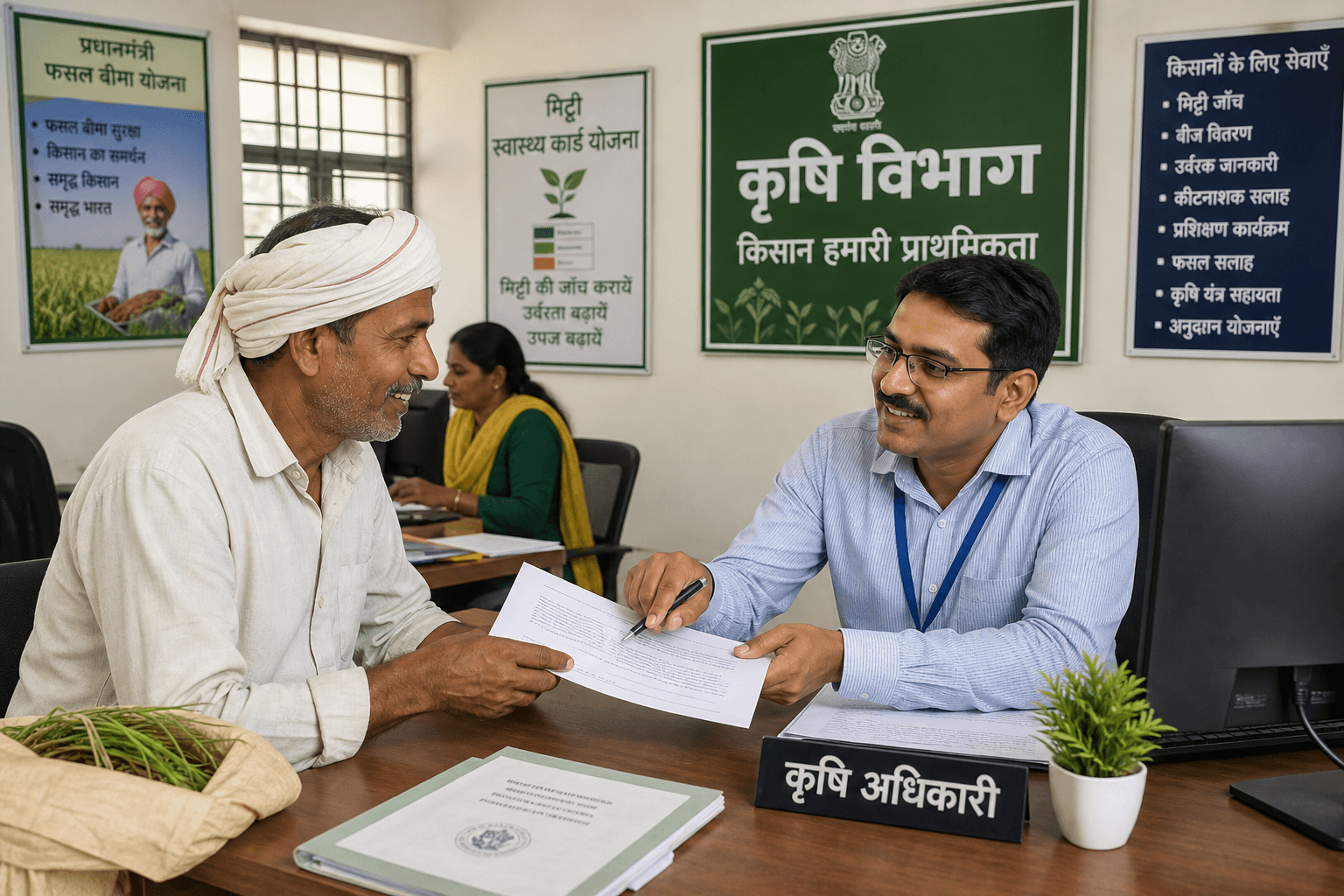
If you search online for "NABARD loan for farmers," you will find dozens of pages promising direct subsidies from NABARD. That is the first thing you need to understand: NABARD does not subsidise farmers directly. The National Bank for Agriculture and Rural Development refinances commercial banks and regional rural banks, channels Government of India scheme funds, and supports rural infrastructure — but your application still goes through your bank branch.
This distinction matters because most modern farming projects — polyhouses, mushroom units, aquaponics setups, warehouses — require a bank term loan plus a back-ended subsidy routed through schemes like NHB, MIDH, or the Agriculture Infrastructure Fund. NABARD sits behind that pipeline. Understanding how it works saves months of wasted applications and helps you stack multiple benefits legally.
What NABARD Actually Does for Farmers
NABARD's role in Indian agriculture finance has three layers that farmers encounter most often:
1. Refinancing banks that lend to you
When your bank sanctions a term loan for a polyhouse or cold storage unit, NABARD may refinance that loan at the backend. The bank assesses your creditworthiness, reviews your DPR, and disburses funds. NABARD provides liquidity and policy support to the bank — not a separate cheque to your home address.
2. Passing through central subsidies
Credit-linked schemes such as NHB commercial horticulture (flat 50% back-ended subsidy, ceiling approximately ₹56 lakh per beneficiary, up to about ₹1 crore depending on structure and location) depend on a sanctioned bank loan. After you build the project and a Joint Inspection Team verifies it against your approved DPR, the subsidy is credited to your loan account, reducing your outstanding balance. NABARD's refinancing mechanism helps banks participate confidently in these long-gestation farm projects.
3. Running targeted sub-schemes
Beyond horticulture, NABARD supports FPO (Farmer Producer Organisation) formation and strengthening, and the AMI (Agriculture Marketing Infrastructure) sub-scheme, which offers 25–33% assistance for warehouses, cold storage, and related post-harvest infrastructure. Mushroom units, aquaponics projects, and other ventures also access NABARD-refinanced credit when banks accept a bankable DPR — typically covering 75–90% of the project cost through bank finance, with your promoter contribution making up the rest.
Crop Loans and Kisan Credit Card — The Everyday Layer
Before you think about a ₹25–40 lakh polyhouse, most farmers interact with NABARD's system through routine crop credit:
- Crop loans up to ₹3 lakh at 7% interest, with an effective 4% rate on prompt repayment thanks to interest subvention.
- Collateral-free agricultural loans up to ₹2 lakh for eligible farmers under RBI priority-sector norms implemented through banks.
These are not project loans. They fund seeds, fertiliser, and seasonal inputs via Kisan Credit Card (KCC) or short-term crop loans. But maintaining a clean repayment record on KCC strengthens your profile when you later apply for a term loan to build a 1,000 sqm polyhouse starter unit costing ₹7–10 lakh (which can fall to ₹3.5–5 lakh after subsidy).
NABARD is the policy backbone; your bank is the front door. Always start at the branch where you hold your KCC or savings account, and ask specifically for term-loan products linked to NHB or AIF schemes.
How NABARD Connects to Polyhouse and Protected Cultivation
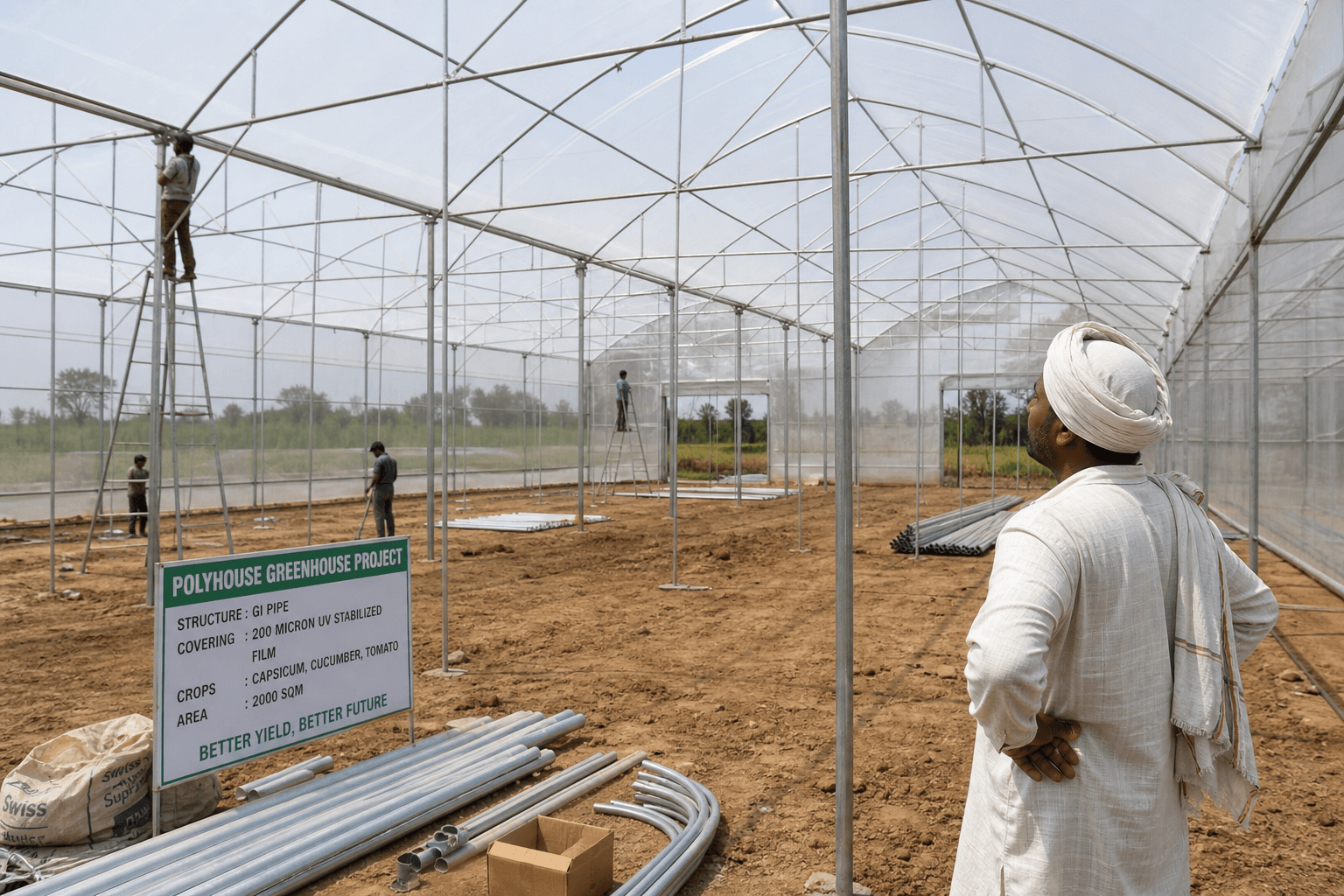
Polyhouse subsidy under NHB/MIDH is credit-linked and back-ended. The process — whether through the legacy Letter of Intent (LOI) plus Joint Inspection Team flow or the simplified 2023 optional Letter of Comfort (LoC) with mobile-app self-inspection — requires:
- A bankable DPR with financial ratios including DSCR ≥ 1.5.
- Bank term-loan sanction before construction begins.
- Application on nhb.gov.in (processing fee approximately ₹5,000–10,000).
- Construction exactly as approved — minimum area 4,000 sqm for general states or 1,000 sqm for NE/hilly areas.
- Inspection and subsidy credit to the loan account.
NABARD does not replace any of these steps, but banks are more willing to sanction horticulture term loans knowing NABARD refinances such portfolios. For a full walkthrough of the subsidy side — including the critical rule that building before LOI/LoC permanently forfeits subsidy — read our Polyhouse Subsidy Guide 2026.
Remember the effective subsidy reality: government cost norms (₹844–1,650 per sqm depending on structure and area slab) often lag 2026 market rates, so the effective subsidy is typically 35–40%, not the advertised 50%. Keep 15–20% extra cash beyond your margin money.
Stacking NABARD-Refinanced Loans with AIF and Other Schemes
One of the most powerful — and least understood — combinations is stacking NHB/MIDH subsidy with the Agriculture Infrastructure Fund (AIF):
| Benefit | Detail |
|---|---|
| AIF corpus | ₹1 lakh crore |
| Interest subvention | 3% on loans up to ₹2 crore for 7 years |
| Credit guarantee | CGTMSE up to ₹2 crore (fee borne by Government) |
| Promoter contribution | Minimum 10% |
| Moratorium | 6 months to 2 years |
| Operational period | 2020–21 to 2032–33 |
| Portal | agriinfra.dac.gov.in |
AIF is stackable with NHB, SMAM, PMKSY subsidies, and your polyhouse term loan. Example path: sanction a ₹30 lakh polyhouse term loan at your bank (NABARD-refinanced at backend), register the project on AIF for 3% interest subvention, apply NHB for 50% back-ended subsidy on eligible cost norm, and add PMKSY drip support at 55% for small/marginal farmers (45% for others, with state top-ups reaching 60–90% in states like UP and Gujarat).
NABARD AMI — When Your Project Is Storage, Not Crops
If your plan is a warehouse or cold storage rather than cultivation, the AMI sub-scheme (25–33%) is the relevant NABARD channel. This supports post-harvest infrastructure — critical if you grow high-value polyhouse crops like coloured capsicum (net return approximately ₹18.14 lakh per acre per annum per Agrifirst NVPH data) and need cold-chain access to mandis or exporters.
AMI assistance is not the same as NHB protected-cultivation subsidy. Some entrepreneurs run both: a polyhouse for production (NHB route) and a small cold room for staging harvests (AMI route). Each requires its own DPR and bank sanction.
Step-by-Step — How a Farmer Actually Gets a NABARD-Linked Project Loan
Step 1: Prepare a bankable DPR
Your DPR must include project at a glance, promoter details (PAN, Aadhaar, GST, caste certificate if applicable, training certificates), disclosure of benefits already availed, market viability, technical specifications (B-Class GI pipes, UV-stabilised polyfilm of approved micron, water EC analysis, drip/fertigation layout), financial viability with DSCR ≥ 1.5, IRR/BCR, debt-equity ratio, break-even analysis, repayment schedule, crop plan with yield and price projections, employment generation, and annexures.
Step 2: Gather documents
Standard checklist: Aadhaar, PAN, SC/ST caste certificate if applicable, land records (Jamabandi, 7-12 and 8-A, Khasra-Khatauni) or a registered (not notarised) lease deed valid 10–15+ years, three to four vendor quotations with GST, soil and water test reports, and Aadhaar-linked bank passbook.
Step 3: Approach your bank for term-loan sanction
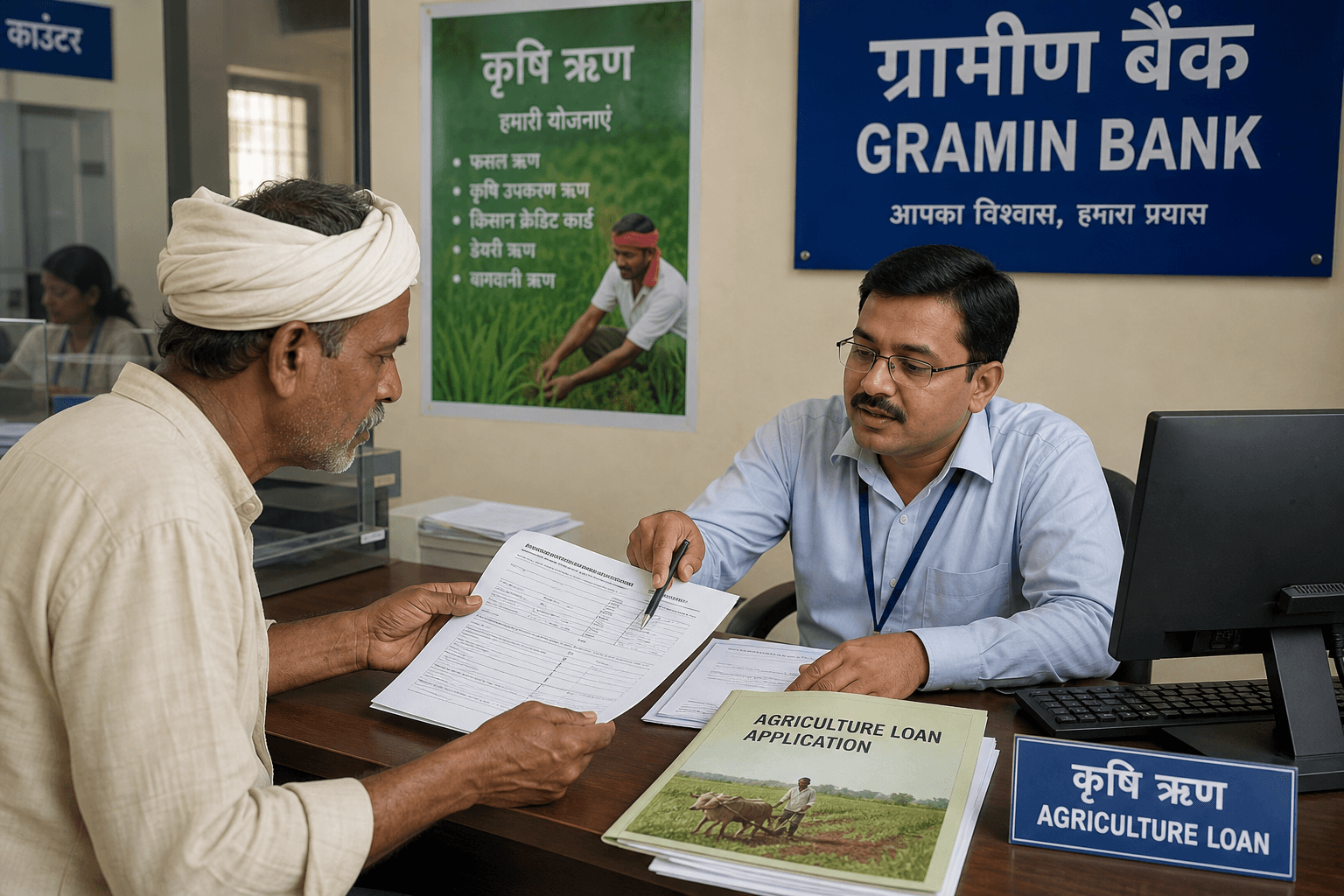
Submit the DPR and request a term loan sized to your promoter contribution (typically 10–40% depending on scheme mix). The bank evaluates collateral, cash flows, and scheme eligibility. NABARD refinancing happens at the institutional level — you will not deal with NABARD directly.
Step 4: Apply for subsidy before construction
For NHB polyhouse projects, apply at nhb.gov.in and obtain LOI or LoC before breaking ground. Apply on your state horticulture portal where required (MahaDBT, MPFSTS, i-Khedut, etc.).
Step 5: Build, document, and inspect
Take geo-tagged construction-stage photos. After completion, the Joint Inspection Team (or app-based self-inspection under the 2023 process) verifies the structure against your approved DPR. Subsidy is then credited to your loan account.
NABARD and Other Modern Farming Ventures
Research data shows NABARD credit linkage extends beyond polyhouses:
- Mushroom farming: NHB subsidy up to 50% (maximum ₹10 lakh on a ₹20 lakh unit) plus 50% on compost; MIDH up to 50%. A 500-bag oyster unit costs ₹50,000–₹1 lakh.
- Aquaponics: No dedicated scheme, but fisheries components may qualify under PMMSY (40% general / 60% for SC-ST-women) or NFDB, with the greenhouse under NHB/NHM. NABARD refinances bank loans covering 75–90% of project cost with a bankable DPR.
- Drone purchases: SMAM subsidy (50% up to ₹5 lakh for individual small/marginal/women/SC-ST farmers) flows through agrimachinery.nic.in, not NABARD directly — but your bank may still finance the farmer's 50% share.
Common Mistakes When Dealing with NABARD-Linked Finance
- Applying to NABARD instead of your bank — NABARD does not accept farmer loan applications at its district office for polyhouse projects.
- Starting construction before loan and subsidy approval — instant disqualification from NHB subsidy.
- Assuming 50% subsidy equals 50% of your actual bill — cost norms cap eligible amounts; budget for 35–40% effective support.
- Weak DPR financials — banks reject projects with DSCR below 1.5.
- Ignoring AIF registration — leaving 3% interest subvention for seven years on the table.
Never begin polyhouse construction before receiving your Letter of Intent or Letter of Comfort and bank term-loan sanction. This is the single most common reason subsidy claims are permanently rejected — and no NABARD refinancing can recover a forfeited NHB grant.
Who Benefits Most from Understanding NABARD's Role?
- Small and marginal farmers upgrading from open-field crops to a 1,000 sqm starter polyhouse.
- FPOs aggregating member land for protected cultivation with bank term loans.
- Agri-entrepreneurs building cold storage under AMI while growing high-value crops under NHB.
- Farmers in credit-linked states where district horticulture departments require bank sanction letters before subsidy approval.
For a complete map of central schemes — NHM, NHB, SMAM, MIDH, PMKSY, AIF, PM-KUSUM, PKVY — see our Government Farming Subsidy Schemes 2026 complete list. If solar pump conversion is part of your plan, the PM-KUSUM Solar Farming Guide explains Component B's 60% subsidy (30% central + 30% state) on pumps up to 7.5 HP.
The Bottom Line
NABARD is the invisible engine behind rural bank lending — not a direct subsidy vending machine. Your practical workflow is: DPR → bank term loan → scheme application → build after approval → inspection → subsidy credited to loan. Stack AIF interest subvention and PMKSY drip support where eligible, and always keep 15–20% extra liquidity beyond plan because government cost norms trail market prices.
Disclaimer: Costs, subsidies, interest rates, and scheme rules change by state, funding window, and year. Always verify on official portals — nabard.org, nhb.gov.in, agriinfra.dac.gov.in, and your state horticulture department — before investing.
Last verified: May 2026
Frequently asked questions
Does NABARD give subsidy directly to farmers?
No. NABARD refinances commercial banks and regional rural banks, and passes through Government of India subsidies on credit-linked schemes such as NHB protected cultivation. Farmers apply at their bank, not at NABARD headquarters.
What is the interest rate on NABARD-backed crop loans?
Crop loans up to ₹3 lakh are available at 7% interest. With prompt repayment, the effective rate can be 4% under the interest subvention scheme. Collateral-free agricultural loans are available up to ₹2 lakh.
Can I combine a NABARD-refinanced term loan with NHB polyhouse subsidy?
Yes. NHB subsidy is credit-linked and back-ended — it is credited to your loan account after Joint Inspection Team verification. You can also stack Agriculture Infrastructure Fund (AIF) interest subvention on the same project loan where eligible.
What does NABARD AMI scheme cover?
The Agriculture Marketing Infrastructure (AMI) sub-scheme under NABARD offers 25–33% assistance for warehouses, cold storage, and related post-harvest infrastructure. This is separate from crop loans and horticulture subsidies.
What documents do I need for a bankable farm project loan?
Typically Aadhaar, PAN, land records or a registered lease deed valid 10–15+ years, a Detailed Project Report (DPR), vendor quotations with GST, soil and water test reports, and bank term-loan sanction letter. Verify exact requirements with your bank and state nodal agency.