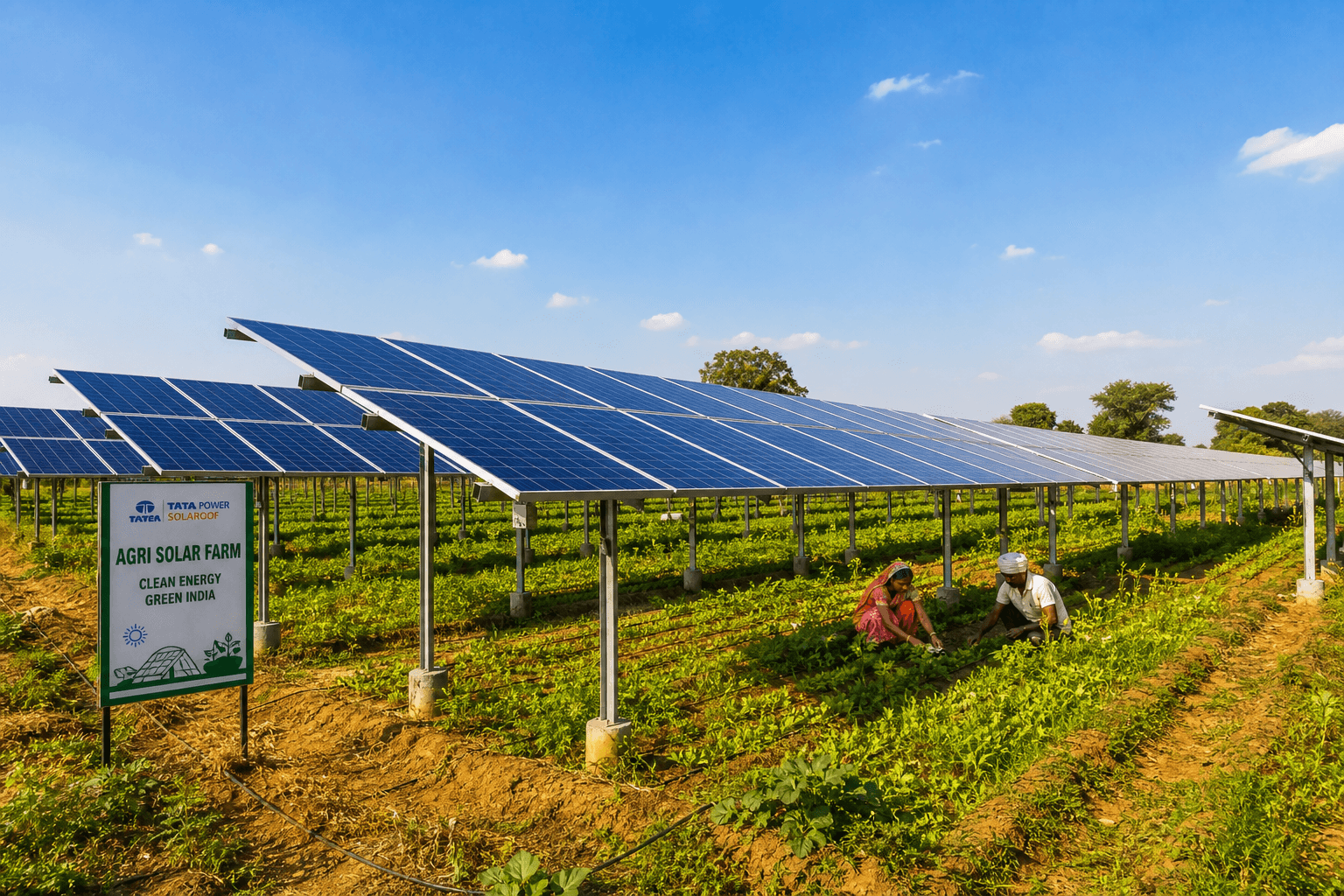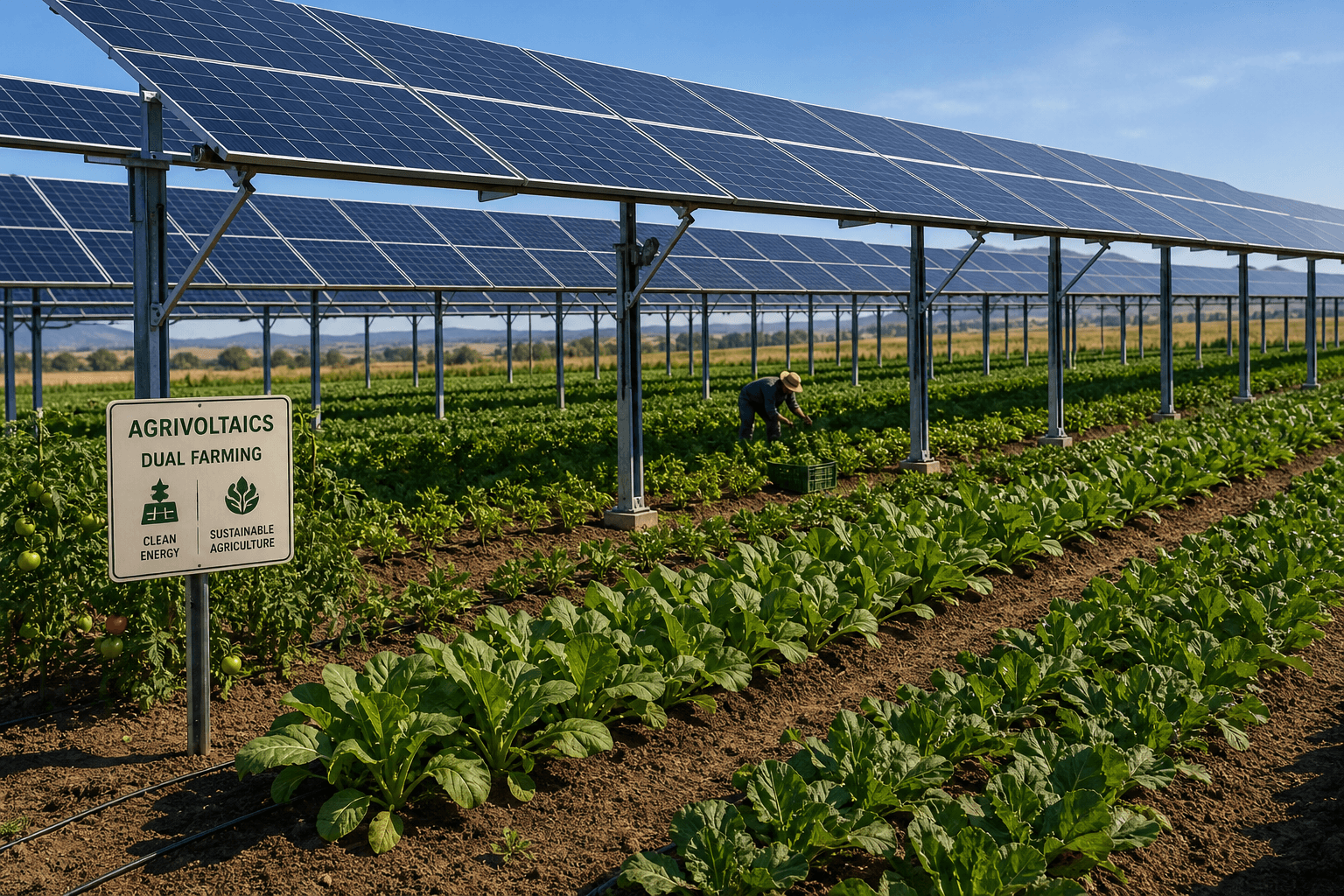
Agrivoltaics sounds like jargon until you stand under a stilt-mounted solar array and still see green chilli or fodder growing in the shade. For Indian farmers with limited land, the idea is irresistible: one acre, two income streams — crops plus solar lease or generation. In March 2026, the government signalled it is betting on that model at scale through PM-KUSUM 2.0 and a 10 GW Agri-PV component. This article explains what was officially announced, what pilots show today, and how to plan without betting on guidelines that are not yet on mnre.gov.in.
For Component A/B/C basics, tariffs, and pump subsidies, start with our PM-KUSUM solar farming guide.
What happened at the National Agro-RE Summit 2026?
At the 4th National Agro-RE Summit in New Delhi (10–11 March 2026), organised by NSEFI with the India Agrivoltaics Alliance, Union Minister Pralhad Joshi stated that the government is preparing PM-KUSUM 2.0, including a dedicated 10 GW Agri-PV component to promote co-location of solar panels with crops.
Key points from the announcement (policy level, not yet operational detail):
- Studies cited suggest agrivoltaics can lift annual incomes from about ₹60,000 per acre to more than ₹1 lakh per acre.
- India's agrivoltaic potential was pegged at 3,000 GW to nearly 14,000 GW — a strategic range, not a near-term build target.
- As of 2026, roughly 50 AgriPV pilots are running (example: ICAR-CAZRI, Jodhpur).
Critical caveat: Detailed PM-KUSUM 2.0 guidelines were not yet released as of March 2026. Treat the 10 GW figure as an announcement, not a live tender rule. Verify on official portal (pmkusum.mnre.gov.in) before altering land use or signing leases.
How agrivoltaics differs from “solar only” on farm land
Classic PM-KUSUM Component A installs 500 kW–2 MW ground or stilt plants; power sells to the DISCOM at SERC-set tariffs (recent examples ₹2.75–3.50/unit) under a 25-year PPA. Capital cost is about ₹4 crore/MW with no capital subsidy on the plant itself. Land requirement is about 4–5 acres/MW within 5 km of a 33/11 kV substation.
Agrivoltaics adds design rules so agriculture continues:
- Stilt-mounted panels raise height for machinery, people, and shade-tolerant crops.
- Dual income: crop revenue + lease or generation revenue.
- Microclimate: partial shade can reduce heat stress in some crops (pilot-specific; not universal).
Minister Joshi’s messaging aligns stilt/agrivoltaic structures with farming beneath panels rather than replacing cultivation with pure brownfield solar.
Income layers on the same acre
Farmers should model three cash flows separately:
1. Crop income (unchanged discipline)
High-value protected crops still follow horticulture economics — e.g. coloured capsicum project data near ₹18.14 lakh net per acre per year in NVPH setups, or cucumber near ₹16.76 lakh — but those figures assume full polyhouse management, not random shade strips. Under partial shade, yields and varieties must match the pilot or agronomist recommendation for your zone. If local trial data is missing, write verify on official portal in your DPR.
2. Land lease
Benchmarks from PM-KUSUM-related citations:
- ~₹30,000 per acre per year (IISD)
- Up to ₹80,000 per hectare per year (government sources)
- Component C land-leasing ~₹25,000 per acre per year (Rajya Sabha reply)
Agrivoltaics leases may exceed standard ground-mount leases when developers need cultivable land — Joshi’s ₹60,000 → ₹1 lakh+ per acre income story combines crop + solar effects; do not assume the full jump is lease alone.
3. Generation revenue (if you are the generator)
Component A’s official median: ₹4.5 lakh per MW per month (~₹54 lakh/MW/year gross) applies to plant owners, not every landless tenant farmer. 11–16% ROI has been estimated for 0.5–2 MW investors in independent analysis (IISD/CEEW/CSTEP, 8 April 2026) — model with your banker, not social media.
PM-KUSUM 2.0 and the Budget boost
Union Budget 2026-27 reporting increased PM-KUSUM allocation from about ₹2,600 crore (BE 2025-26) to ₹5,000 crore (~92%). That signals political commitment to solarise agriculture further — including pumps (Component B: 60% subsidy, 50% central in NE) and feeders (Component C). Agri-PV is the next chapter; budget headroom does not replace waiting for written guidelines.
National uptake as of 30 Nov 2025: 20.42 lakh farmers benefited under PM-KUSUM broadly; Component A sat near 8.4% of its 10,000 MW target — implementation capacity and grid connectivity remain bottlenecks agrivoltaics must solve with better design standards.
What pilots teach while you wait for 2.0
Roughly 50 national AgriPV pilots mean:
- Crop choice matters — shade-tolerant or partial-shade trials differ from full-sun polyhouse capsicum.
- Panel height and row spacing affect tractor access and drip lines.
- Water — drip/fertigation (PMKSY subsidies 45–55% central plus state top-ups) still drives yield under shade.
- Institutional partners — ICAR institutes, state agriculture universities, and DISCOMs coordinate; individual farmers should enter via state nodal agency channels, not informal middlemen.
Document everything: Khasra/Khatauni, Aadhaar, bank passbook, and whether lease or PPA splits revenue fairly for 25 years.
Stilt structures vs ground mount — farmer decision tree
| Question | If “yes” | Direction |
|---|---|---|
| Is land still needed for active cropping? | Yes | Favour stilt / Agri-PV track (future 2.0; pilots now) |
| Is land barren and far from daily farming? | Yes | Component A ground mount may be simpler |
| Only need cheaper irrigation? | Yes | Component B pump (payback under 2 years cited for 5 HP switch) |
| Have grid pump and want surplus sale? | Yes | Component C |
Risks specific to agrivoltaics
- Guideline gap — Signing land away before 2.0 rules clarify crop rights and shade liability.
- Crop mismatch — Planting full-sun hybrids under panels without trial data.
- Lease vs ownership — Lessors may capture most ₹4.5 lakh/MW/month economics; read 25-year terms.
- Substation distance — Still applies to grid-connected Agri-PV at MW scale (4–5 acres/MW, 5 km substation rule for Component A class projects).
- Optimistic social media — ₹1–2 lakh/acre lease claims are outlier highs; plan at ₹25,000–30,000/acre unless your DISCOM offer is written.
Do not bulldoze standing crops or erect unauthorized stilts expecting retroactive PM-KUSUM 2.0 subsidy. Until mnre.gov.in publishes Agri-PV norms, treat projects as pilot, lease, or Component A with explicit DISCOM and nodal-agency approval — same discipline as polyhouse apply-before-build rules for horticulture subsidies.
How agrivoltaics connects to protected cultivation
Many progressive farms pair:
- Polyhouse on irrigated high-value blocks (polyhouse cost & profit guide)
- Agri-PV on marginal strips or stilt alleys over field crops
- PM-KUSUM pumps for water security
NHB polyhouse subsidy still requires apply before construction and DPR match — solar plans on the same survey number must be disclosed to avoid conflicts. See polyhouse subsidy guide 2026.
Small and marginal farmers — realistic entry
If 10 GW Agri-PV rolls out with farmer-friendly lease minimums, smallholders could earn lease income without owning ₹4 crore/MW plants. Until then:
- Join state nodal agency waitlists and pilot expressions of interest.
- Keep land title clear — disputes block PPAs.
- Prefer registered leases (horticulture schemes already demand 10–15+ year registered leases for subsidy; solar lessors will mirror this).
Our small & marginal farmer modern farming roadmap (when live) sequences shade net, drip, pump, then scale — agrivoltaics fits after water and crop basics are stable.
What to do in 2026 (action list)
- Read PM-KUSUM solar farming guide for Components A/B/C math.
- Monitor pmkusum.mnre.gov.in for PM-KUSUM 2.0 PDF guidelines.
- Ask your state nodal agency (UPNEDA, TEDA, etc.) about AgriPV pilots — cite ICAR-CAZRI example if they need a reference.
- Model conservative lease + crop budget; treat Joshi’s income uplift as study-based, not promised DBT.
- For MW-scale ownership, confirm PPA within 2 months of Letter of Award feasibility with your DISCOM.
Bottom line
Agrivoltaics is the policy direction; PM-KUSUM 2.0’s 10 GW Agri-PV is the scale target; ~50 pilots are the classroom. Farmers should prepare land records, crop plans, and lease literacy now — but hold major capital moves until guidelines land. Dual income is credible at the pilot and lease level today; national rules are still catching up.
Announcement cited: March 2026 National Agro-RE Summit. Last updated May 2026. Verify on pmkusum.mnre.gov.in.
Frequently asked questions
What is agrivoltaics (Agri-PV)?
Agrivoltaics means growing crops under or between solar panels — often on stilt-mounted structures — so the same land earns from both harvests and electricity sales or lease. PM-KUSUM 2.0 (announced March 2026) is preparing a dedicated 10 GW Agri-PV component; operational guidelines were not yet released as of that announcement.
How much extra income can agrivoltaics add per acre?
At the 4th National Agro-RE Summit (March 2026), Minister Pralhad Joshi cited studies showing annual incomes rising from about ₹60,000 per acre to more than ₹1 lakh per acre. Land lease under standard PM-KUSUM Component C has been cited around ₹25,000 per acre per year; IISD cites about ₹30,000 per acre per year for leases, with higher potential under agrivoltaics — verify locally.
Is PM-KUSUM 2.0 already open for applications?
As of March 2026, detailed PM-KUSUM 2.0 guidelines were not yet released. Treat the 10 GW Agri-PV target as a policy announcement, not an operational rule. Meanwhile, about 50 AgriPV pilots exist nationally (e.g. ICAR-CAZRI, Jodhpur). Check pmkusum.mnre.gov.in for updates.
Can I still use Component A on my farm land?
Component A allows 500 kW–2 MW plants on barren, fallow, or cultivable land with power sold to DISCOM under a 25-year PPA. Stilt/agrivoltaic structures are positioned to let farming continue beneath panels for dual income. See the main PM-KUSUM guide for tariffs and the ₹4.5 lakh/MW/month official median income figure.