If you own two acres, rely on monsoon timing, and watch input costs eat your mandi margin every season, "modern farming" can sound like something only large entrepreneurs with crore-scale polyhouses afford. That is not true. Research data shows a sequenced roadmap — drip first, solar pump second, protected cultivation third, precision tools fourth — lets small and marginal farmers upgrade with subsidies covering 45–95% of individual components when applied correctly.
This roadmap is designed for farmers classified as small or marginal under land-holding norms, SC/ST beneficiaries seeking enhanced rates, and women farmers accessing programmes like Namo Drone Didi. It uses only verified scheme data and honest cost ranges. Every step links to deeper guides on this site.
Where You Are Starting From
Small and marginal farmers typically face:
- Water uncertainty — borewell depth increasing, canal supply irregular
- Input cost spikes — fertiliser and pesticide without matching yield gain
- Labour shortages — peak spraying and harvest windows missed
- Price volatility — tomato and onion crashes while capsicum in polyhouse holds ₹75–150 per kg in peak months (October–December)
- Credit gaps — collateral-free crop loans up to ₹2 lakh and crop loans up to ₹3 lakh at 7% (effective 4% on prompt repayment) through KCC, but no experience with term loans or DPRs
The roadmap addresses each constraint in order of cost and complexity — not jumping straight to a ₹25–40 lakh per acre polyhouse without irrigation fundamentals.
Phase 1 (Year 1) — Water Efficiency and Solar Pump
Step 1A — PMKSY drip irrigation (Month 1–3)
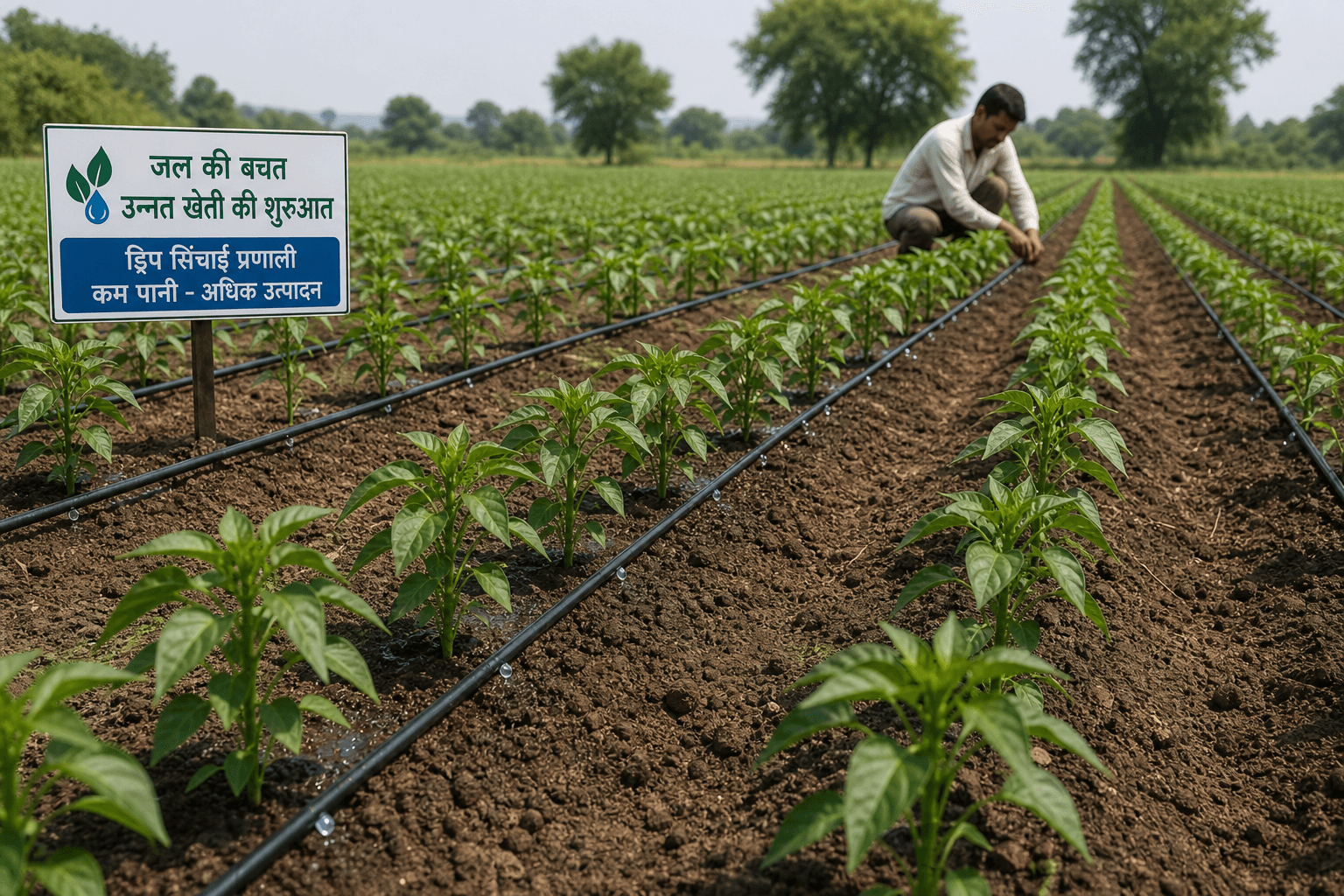
Scheme: PMKSY "Per Drop More Crop" Your subsidy rate: 55% central support as a small/marginal farmer (45% for others) State top-ups: UP up to 90% for small farmers, 65–80% for others; Gujarat +10% in dark zones; Rajasthan 60% on pipelines Ceiling: 5 hectares per beneficiary; same land eligible again after 7 years
Benefits:
- Saves approximately 70% water
- Saves approximately 40% fertiliser
- 20–30% yield gain on most horticultural crops
- Foundation for later polyhouse fertigation
Apply: State portal (e.g., MPFSTS at mpfsts.mp.gov.in) with Aadhaar-seeded DBT bank account. Some states (MP) select via lottery — apply early in the funding window.
Cost reality: Even after subsidy, budget the farmer share plus annual drip maintenance (flushing lines, replacing laterals).
Read the full guide: Drip Irrigation & Fertigation Subsidy under PMKSY.
Step 1B — PM-KUSUM Component B solar pump (Month 3–6)
Scheme: PM-KUSUM standalone solar pump (up to 7.5 HP) Subsidy: 60% (30% central + 30% state); 50% central in NE/hilly/island UTs with state adding ≥30% Farmer share: 10% cash + 30% loan Economics: 5 HP diesel-to-solar switch costing ₹3–4 lakh drops to ₹1.2–1.6 lakh after subsidy; payback under two years
Why now: Reliable zero-cost pumping makes drip perform consistently and qualifies you for protected cultivation later. As of 30 November 2025, 20.42 lakh farmers had benefited nationally — Maharashtra leads with 11,21,416 beneficiaries.
Apply: State nodal agency (UPNEDA, TEDA, etc.) or pmkusum.mnre.gov.in Documents: Land records (Khasra/Khatauni), Aadhaar, bank passbook
Read the full guide: PM-KUSUM Solar Farming Guide.
Phase 1 total farmer cash outlay (drip share + solar pump 10% contribution) typically runs ₹40,000–₹1.5 lakh depending on farm size and state top-ups — achievable on KCC without a term loan if repayment discipline is strong.
Phase 1 outcome: Irrigated, fertigated open-field or orchard crops with lower input cost. Revenue boost funds Phase 2 savings.
Phase 2 (Year 2) — Protected Cultivation Entry
You now have two entry options depending on capital and state subsidy:
Option A — Shade net house (lower cost)
Cost norm: ₹710 per sqm Subsidy: 50% general; up to 80% for small/marginal/SC/ST in MP Best for: Nurseries, leafy vegetables, hot humid zones needing airflow Area: Start 200–500 sqm on part of your land
Shade net teaches protected cultivation skills — climate monitoring, IPM, scheduled harvesting — without full polyhouse capital exposure.
Option B — 1,000 sqm polyhouse starter (higher return)
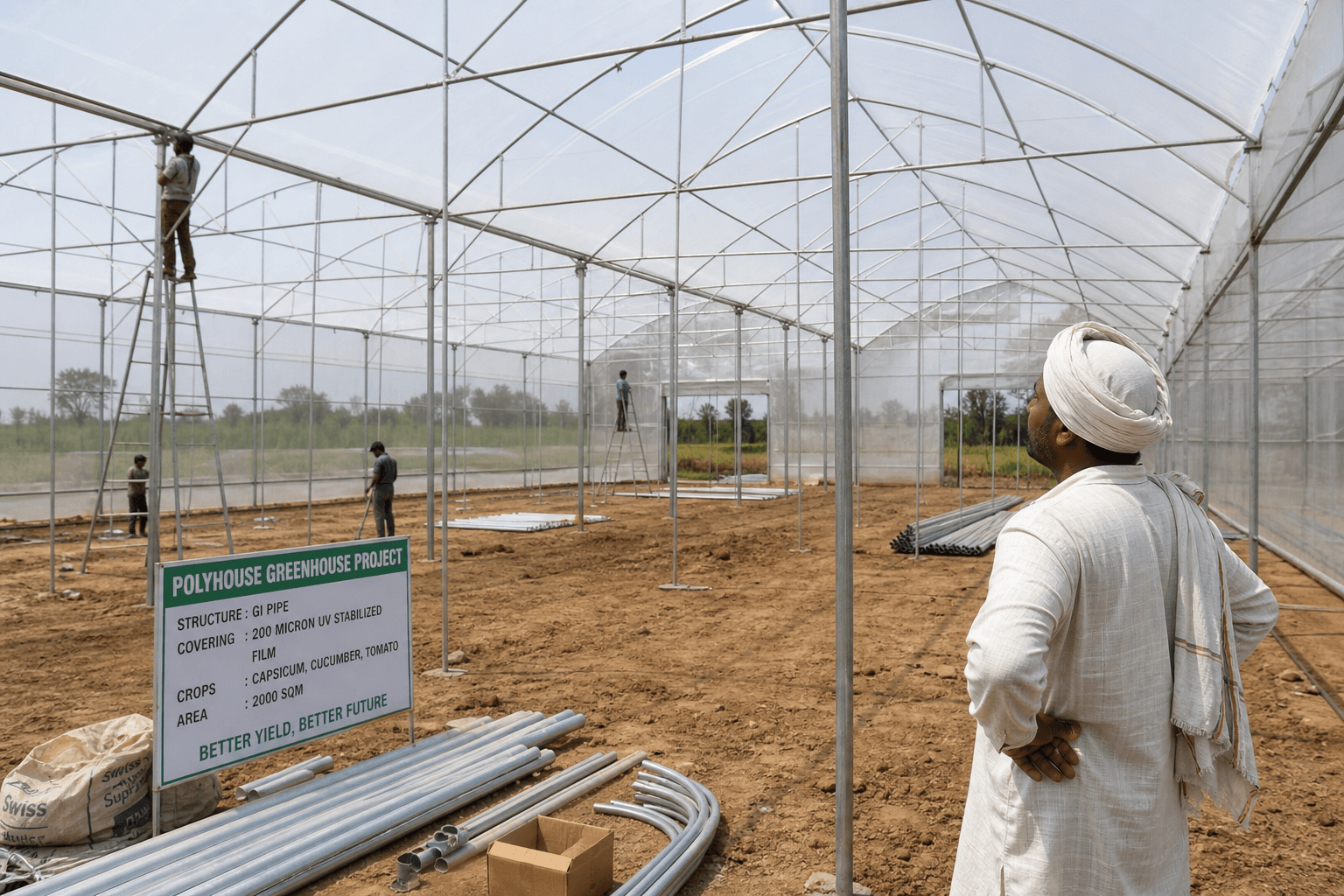
Cost: ₹7–10 lakh before subsidy, falling to ₹3.5–5 lakh after subsidy Minimum area: 1,000 sqm for NE/hilly under NHB; 4,000 sqm for general states on commercial route Best crops: Seedless cucumber (harvest from ~35 days, 2–3 cycles per year, net ₹16.76 lakh per acre benchmark) or cherry tomato (more salt-tolerant than capsicum)
Critical compliance — do not skip
- Write a bankable DPR with DSCR ≥ 1.5 — see How to Write a DPR for Polyhouse Subsidy
- Obtain bank term-loan sanction
- Apply NHB on nhb.gov.in → receive LOI or LoC before construction
- Build exactly as approved → JIT inspection → subsidy credited to loan
Never start polyhouse or shade net construction before LOI/LoC. Small farmers lose the most when forfeiting subsidy — the forfeiture turns a ₹3.5 lakh plan into a ₹10 lakh full-price burden. Read our Polyhouse Subsidy Guide 2026 for the effective 35–40% subsidy reality.
Enhanced rates for SC/ST and small farmers — verify your state
| State | Enhanced Rate | Portal |
|---|---|---|
| Telangana | 95% SC/ST (up to 3 acres) | horticulture.tg.nic.in |
| MP | 80% small/marginal/SC/ST | mpfsts.mp.gov.in |
| Haryana | SC owner 85%, SC lease 65% | hortharyana.gov.in |
| Rajasthan | 70–95% SC/ST and small/marginal | RajKisan |
| Assam & NE | 90% central share (HMNEH) | dirhorti.assam.gov.in |
General baseline is 50% central everywhere. State percentages are indicative — verify on your portal before budgeting.
Phase 2 outcome: First protected cultivation revenue. Skill base for high-value crops.
Phase 3 (Year 3) — Scale and Precision
With one successful protected cultivation cycle and clean loan repayment:
Scale protected area
Move from 1,000 sqm starter to 4,000 sqm (≈1 acre) NVPH if in a general state. Naturally ventilated polyhouse costs ₹25–40 lakh per acre before subsidy; net profit ₹6–14 lakh per year for well-managed units; investment recovered in 2–4 years.
Upgrade crop: Coloured capsicum — net ₹18.14 lakh per acre per year (Agrifirst NVPH data); best profit-versus-risk balance for first-timers at scale. Yield 32–50 tonnes per acre; price ₹75–150 per kg.
Add SMAM drone (own or CHC)
Individual small/marginal/women/SC/ST: 50% up to ₹5 lakh Women SHGs (Namo Drone Didi): 80% up to ₹8 lakh plus free pilot training Coverage: 1 acre in 7–8 minutes; SHGs report 15–30% yield increases Rule: DGCA-approved Indian drones only — no DJI
If capital is tight, use a neighbour's Custom Hiring Centre (CHC) under SMAM rather than owning a drone.
Read: Drone Farming & SMAM Subsidy Guide.
Stack Agriculture Infrastructure Fund
Register on agriinfra.dac.gov.in for 3% interest subvention on loans up to ₹2 crore for 7 years. Stackable with NHB and PMKSY. Reduces term-loan burden as you scale.
Read: NABARD Loan for Farmers — Process & Subsidy Pass-Through.
Phase 3 outcome: Full-acre protected cultivation with precision input application and lower interest cost.
Phase 4 (Year 4+) — Diversification and Dual Income
Organic certification (optional)
PKVY: ₹31,500 per hectare over 3 years (₹15,000 DBT for inputs); cluster model at 20 hectares Since 2015–16: 14.99 lakh hectares covered; 52,289 clusters; 25.30 lakh farmers (as of February 2025) Export pathway: APEDA supports certification; Sikkim and Kerala lead organic exports
Read: Organic & Export Farming — PKVY Guide.
Low-capital side ventures
| Venture | Entry Cost | Subsidy Route |
|---|---|---|
| Oyster mushroom (500 bags) | ₹50,000–₹1 lakh | NHB 50% max ₹10 lakh |
| Backyard aquaponics (150 sqft) | ₹60,000–65,000 | PMMSY fisheries + NHB shell |
| Vertical farming (small indoor) | ₹8 lakh+ | NHB protected cultivation |
These diversify income without replacing your core polyhouse operation.
PM-KUSUM Component C — solarise grid-connected pump
Component C: Solarisation of grid-connected pumps; surplus sold to DISCOM CFA: 30% of benchmark; feeder solarisation ₹1.05 crore per MW Land lease income: approximately ₹25,000 per acre per year (MoS Rajya Sabha reply)
PM-KUSUM 2.0 agrivoltaics (watch for guidelines)
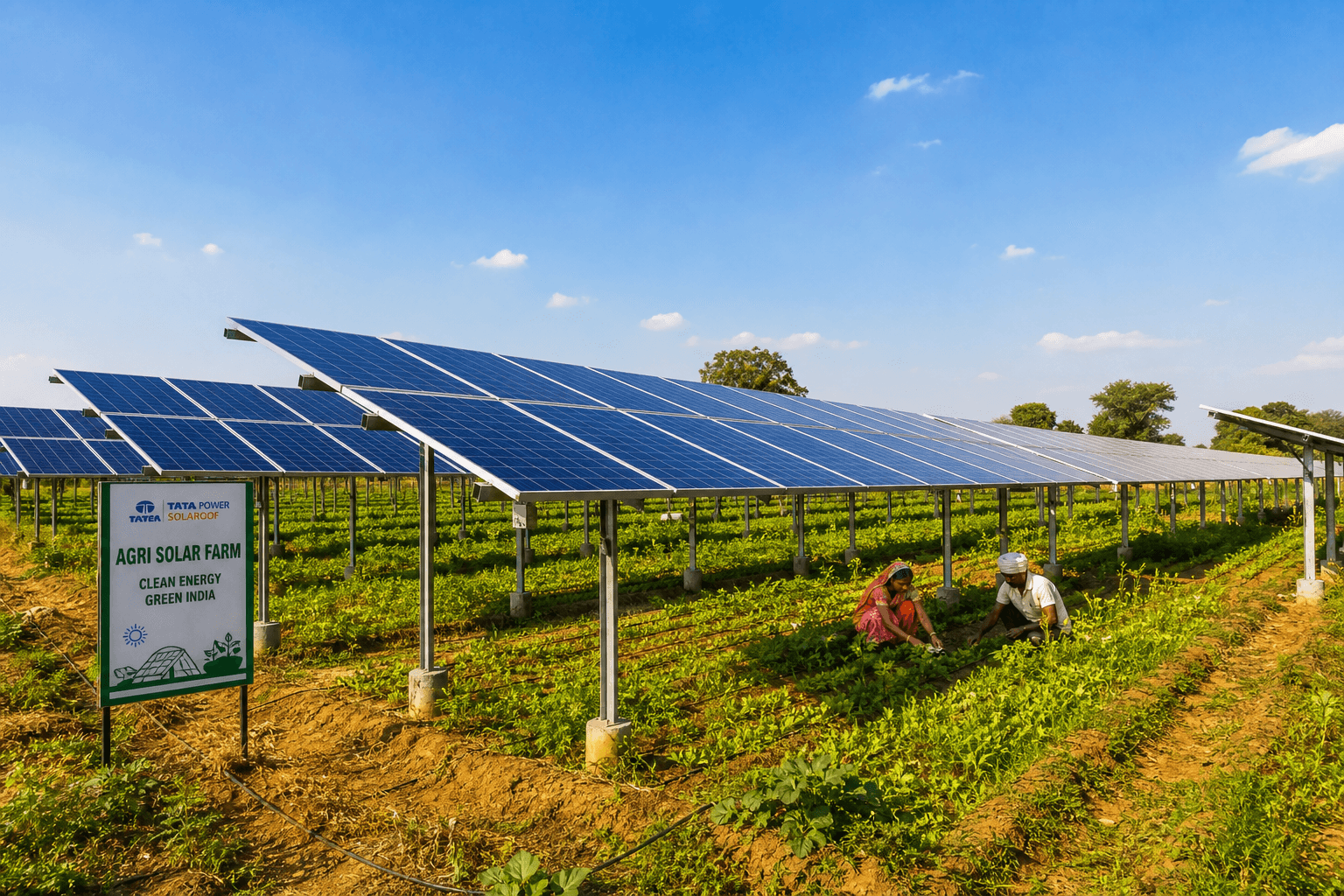
At the 4th National Agro-RE Summit (March 10–11, 2026), Minister Pralhad Joshi announced PM-KUSUM 2.0 with a dedicated 10 GW Agri-PV component. Studies cited incomes rising from about ₹60,000 per acre to more than ₹1 lakh per acre. Detailed guidelines were not yet released as of March 2026 — treat as announcement, not operational rule.
Union Budget 2026–27: PM-KUSUM allocation raised from approximately ₹2,600 crore to ₹5,000 crore (~92% increase).
Read: Agrivoltaics — PM-KUSUM 2.0.
Roadmap Summary Table
| Phase | Timeline | Investment | Key Schemes | Farmer Cash (indicative) |
|---|---|---|---|---|
| 1 | Year 1 | Drip + solar pump | PMKSY 55%, PM-KUSUM B 60% | ₹40K–₹1.5L |
| 2 | Year 2 | Shade net or 1,000 sqm polyhouse | NHB/MIDH 50%+ state top-up | ₹1.5L–₹5L |
| 3 | Year 3 | Scale to 1 acre + drone | NHB, SMAM 50%, AIF 3% | ₹5L–₹15L |
| 4 | Year 4+ | Organic, aquaponics, agrivoltaics | PKVY, PMMSY, PM-KUSUM 2.0 | Variable |
Documents to Maintain From Day One
Build a subsidy file folder (physical and digital) containing:
- Aadhaar, PAN, caste certificate (if SC/ST)
- Land records or registered lease deed 10–15+ years
- Aadhaar-seeded bank passbook
- KCC repayment record (strengthens term-loan application)
- Water and soil test reports (update every 2 years)
- Training certificates from KVK
- All vendor quotations with GST
- Geo-tagged photos from every construction phase
- Copies of every scheme application and sanction letter
This folder becomes your DPR annexure set when you apply for NHB in Phase 2.
Mistakes Small Farmers Make on This Roadmap
- Skipping Phase 1 — polyhouse without drip/fertigation wastes water and nutrients
- Building before LOI/LoC — permanent subsidy forfeiture; see 9 Mistakes That Cancel Your Farming Subsidy
- Trusting 50% headline without cost-norm math — keep 15–20% extra cash
- Growing low-value crops in expensive infrastructure — match capsicum/cucumber to polyhouse, not spinach
- Not verifying state portal rates — Telangana 95% and MP 80% do not apply in every state
Credit Path for Small Farmers
You do not need crore-scale wealth to start:
- KCC crop loan: up to ₹3 lakh at 7%, effective 4% on prompt repayment
- Collateral-free agri loan: up to ₹2 lakh
- NABARD-refinanced term loan: for Phase 2 polyhouse after bank accepts your DPR; NABARD does not lend directly but enables bank participation
- AIF moratorium: 6 months to 2 years before full EMI on infrastructure loans
Maintain clean KCC repayment in Phase 1 — banks reference this when sanctioning Phase 2 term loans.
The Bottom Line
Small and marginal farmers do not need to leap directly to a ₹40 lakh polyhouse. The proven 2026 roadmap is: PMKSY drip and PM-KUSUM solar pump in Year 1, shade net or 1,000 sqm starter polyhouse with NHB subsidy in Year 2 (only after DPR, bank sanction, and LOI/LoC), scale to full-acre capsicum with SMAM drone and AIF interest subvention in Year 3, and diversify with organic, mushroom, or agrivoltaics in Year 4+. Enhanced subsidy rates for SC/ST and small farmers in states like Telangana, MP, and Haryana can cut your share dramatically — but only if you verify on your state portal and follow the compliance sequence every step of the way.
For the complete scheme landscape, see Government Farming Subsidy Schemes 2026 — Complete List.
Disclaimer: Subsidy percentages, cost norms, and scheme windows change by state and year. Always verify on nhb.gov.in, mnre.gov.in, agriinfra.dac.gov.in, agrimachinery.nic.in, and your state horticulture portal before investing.
Last verified: May 2026
Frequently asked questions
What is the cheapest modern farming upgrade for a small farmer?
PMKSY drip irrigation is the lowest-cost entry point — 55% central support for small and marginal farmers (45% for others), with state top-ups reaching 60–90% in states like UP and Gujarat. It saves approximately 70% water, 40% fertiliser, and boosts yields 20–30%. A shade net house (cost norm ₹710 per sqm, up to 80% subsidy for small/marginal/SC/ST in MP) is the next step.
What size polyhouse should a small farmer start with?
A 1,000 sqm starter unit costs ₹7–10 lakh before subsidy, falling to ₹3.5–5 lakh after subsidy. This is the practical entry point for beginners. NE and hilly areas qualify at 1,000 sqm minimum under NHB; general states require 4,000 sqm for full NHB commercial route.
Can small farmers get PM-KUSUM solar pump subsidy?
Yes. PM-KUSUM Component B offers 60% subsidy (30% central + 30% state) on standalone solar pumps up to 7.5 HP — 50% central share in NE/hilly/island UTs with state adding at least 30%. A 5 HP diesel-to-solar switch costing ₹3–4 lakh drops to ₹1.2–1.6 lakh after subsidy with payback under two years.
In what order should I adopt modern farming technologies?
Recommended sequence — Year 1 PMKSY drip plus PM-KUSUM solar pump; Year 2 shade net or 1,000 sqm polyhouse starter with NHB subsidy after DPR and LOI/LoC; Year 3 scale to full-acre polyhouse or add SMAM drone/FPO services; Year 4-plus consider PM-KUSUM Component C solarisation or agrivoltaics when PM-KUSUM 2.0 guidelines release.
Do small farmers get higher subsidy percentages?
Yes, in many states. MP offers 80% for small/marginal/SC/ST on protected cultivation. Telangana offers 95% for SC/ST on polyhouse up to 3 acres. PMKSY gives 55% central support for small/marginal farmers versus 45% for others. Always verify current rates on your state portal.