Agricultural drones have moved from exhibition demos to district-level subsidy counters. Under the Sub-Mission on Agricultural Mechanisation (SMAM) and the high-profile Namo Drone Didi programme, Indian farmers, FPOs, women Self Help Groups, and agri-graduates can now access 40–100% financial assistance on DGCA-approved drones — provided they follow the right application route and buy the right equipment.
This guide explains who gets what, how to apply on agrimachinery.nic.in, why imported DJI drones will get your claim rejected, and how drone services fit into a broader modern farming plan alongside drip irrigation, polyhouse cultivation, and solar pumps.
Why Drones Matter for Indian Farmers
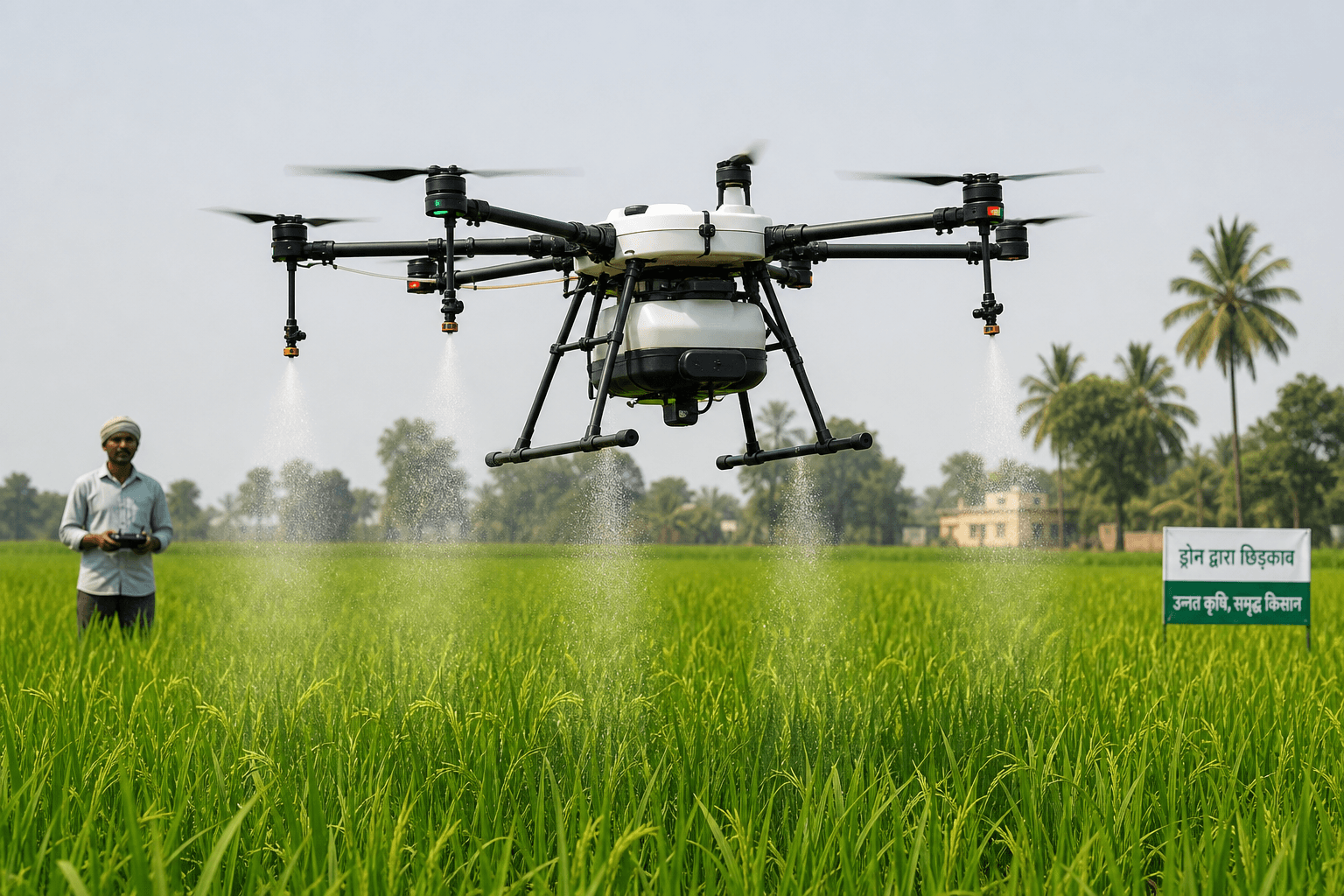
Precision farming with drones addresses three persistent farm-level problems: uneven chemical application, delayed pest detection, and labour shortages during peak spraying seasons. Research data shows that a single agricultural drone can cover 1 acre in 7–8 minutes — work that might take a farm worker half a day on foot with a knapsack sprayer.
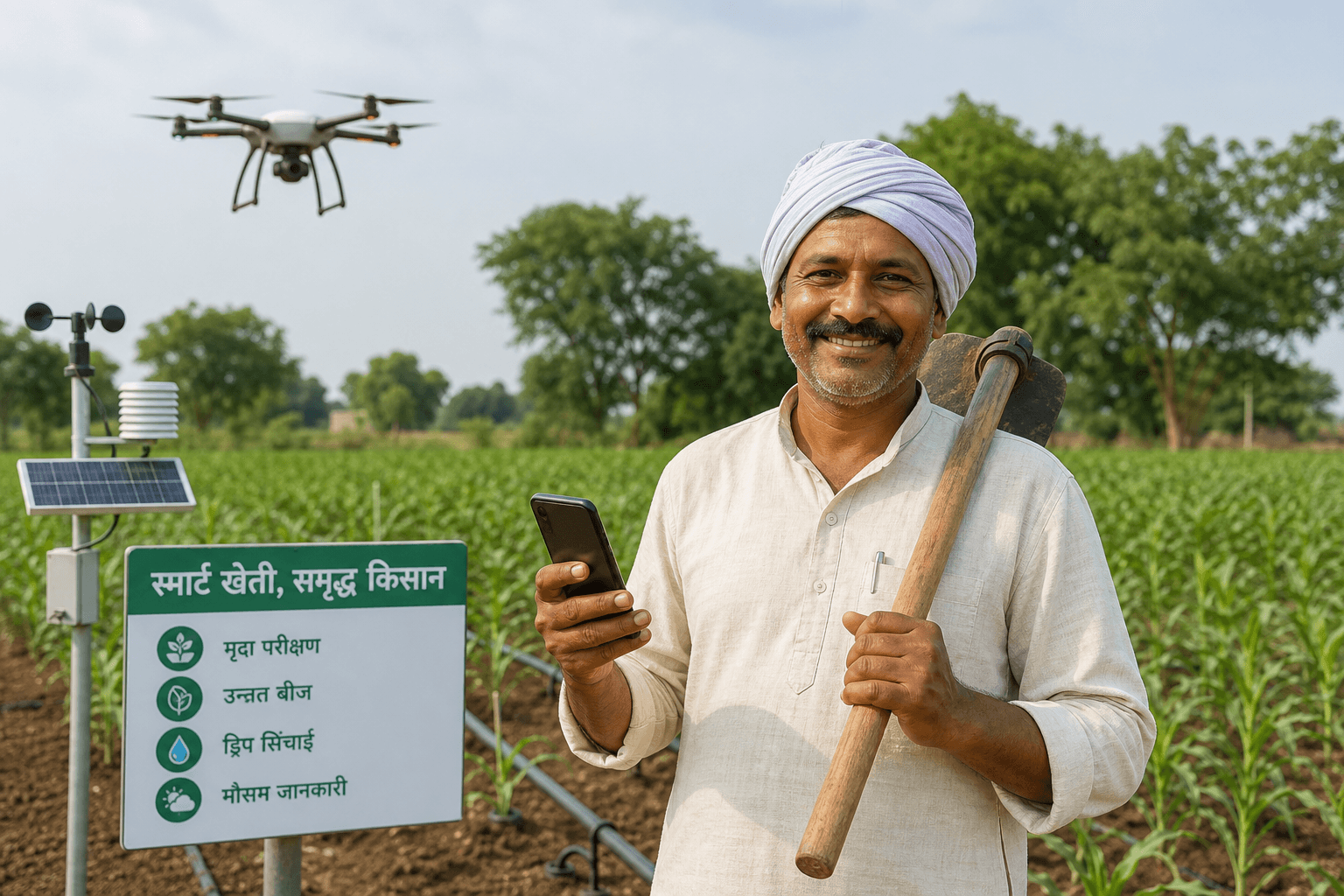
Women SHGs operating under Namo Drone Didi report 15–30% yield increases, attributed to uniform nano-urea and pesticide application, faster response to pest outbreaks, and better input economics per acre. Drones also support mapping, seed broadcasting in some configurations, and data collection for fertigation scheduling — especially valuable when paired with PMKSY drip systems that save approximately 70% water and 40% fertiliser while boosting yields 20–30%.
Drones are not a replacement for soil health management or market linkage. They are a labour and input-efficiency multiplier — most powerful when stacked with other subsidised infrastructure.
SMAM Drone Subsidy — Who Gets How Much
The SMAM framework treats different beneficiary categories differently. Here is the breakdown from official scheme data:
| Beneficiary | Subsidy Rate | Maximum Assistance |
|---|---|---|
| Individual small/marginal/women/SC-ST farmers | 50% | ₹5 lakh |
| Agriculture graduates | 50% | ₹5 lakh |
| FPOs / Custom Hiring Centres (CHCs) | 40% | ₹4 lakh |
| KVKs / SAUs / ICAR institutes | 100% | ₹10 lakh |
Some field reports cite FPO/CHC assistance up to 75% or ₹7.5 lakh in specific state implementations — verify the current cap on agrimachinery.nic.in for your state before budgeting.
Custom Hiring Centres and Village-Level Farm Machinery Banks
SMAM also supports Custom Hiring Centres (CHCs) and Village-Level Farm Machinery Banks, which let farmers access drones without owning one outright. An FPO or entrepreneur sets up a CHC with subsidised equipment — including drones — and hires it out per acre. This model suits smallholders who cannot justify a full drone purchase but want precision spraying on high-value crops like coloured capsicum (net return approximately ₹18.14 lakh per acre per year in well-managed naturally ventilated polyhouses) or seedless cucumber (₹16.76 lakh per acre net).
Only DGCA-approved Indian drones qualify for SMAM subsidy. DJI and other imported drones are not allowed. Submitting quotations for non-approved models leads to automatic rejection — and no appeal path for the subsidy component.
Namo Drone Didi — 80% Support for Women SHGs
Namo Drone Didi is the flagship women's empowerment layer on top of SMAM. Key facts:
- 80% subsidy up to ₹8 lakh for women Self Help Groups purchasing agricultural drones.
- Free pilot training included — addressing the skills gap that otherwise limits drone adoption.
- 15,000 drones targeted under a ₹1,261 crore outlay from 2023-24 to 2025-26.
- Operates under the Lakhpati Didi umbrella, linking drone services to rural women's income goals.
For a women-led SHG in a horticulture cluster, the economics are compelling: purchase a ₹10 lakh DGCA-approved drone with ₹8 lakh subsidised, invest in training, and offer spraying services to neighbouring farms at ₹300–500 per acre. At 20 acres per day operational capacity (assuming battery swaps and logistics), service revenue can repay the farmer's ₹2 lakh share within one to two seasons.
How to Apply — agrimachinery.nic.in and DBT 2.0
Applications flow through the national farm machinery portal:
- Register on agrimachinery.nic.in with Aadhaar-linked details.
- Select SMAM drone component or the Namo Drone Didi portal (launched July 2025 alongside DBT 2.0).
- Upload quotations from authorised vendors for DGCA-approved Indian drone models only.
- Submit land/credential documents as required — farmer category certificate, caste certificate if SC/ST, SHG registration for Namo Drone Didi.
- Await approval and purchase after sanction letter — subsidy is typically back-end or direct-to-vendor depending on state DBT implementation.
- Maintain usage logs — some states require proof of hectares sprayed for audit.
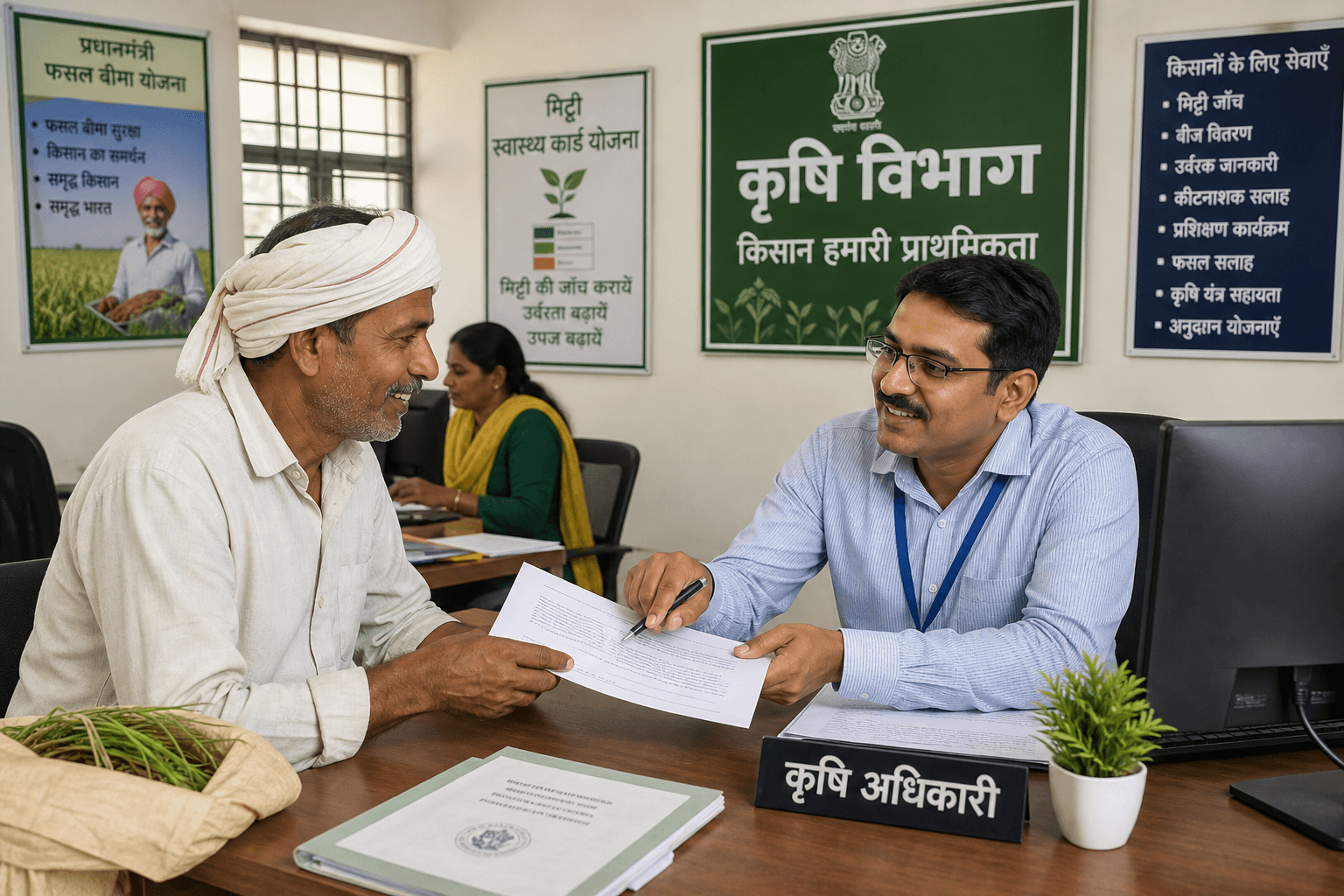
Several states route final verification through the district agriculture officer or the State Agriculture Department nodal cell. If your state uses a lottery system (similar to MP's PMKSY drip selection), apply early in the funding window.
DGCA Approval — The Non-Negotiable Filter
India's drone regulations require type certification from the Directorate General of Civil Aviation (DGCA) for unmanned aerial systems used commercially. SMAM subsidy is tied exclusively to this approved list.
Practical implications:
- Reject DJI and grey-market imports — even if a local dealer offers a " agriculture kit."
- Insist on DGCA type certificate number on the vendor quotation before uploading to the portal.
- Check firmware and spray payload compliance — not every Indian drone model is configured for agricultural spraying.
- Keep invoice, GST, and serial number records for audit — subsidy clawback happens on non-compliant purchases.
This rule connects directly to broader subsidy discipline. Just as building a polyhouse before receiving your Letter of Intent or Letter of Comfort permanently forfeits NHB subsidy, buying a non-approved drone permanently forfeits SMAM assistance.
Stacking Drones with Other Modern Farming Investments
Smart farmers treat drones as one layer in a stacked modernisation plan:
Layer 1 — Water efficiency (PMKSY)
Install drip irrigation with 55% central support for small/marginal farmers (45% for others, state top-ups to 60–90%). Drip saves ~70% water and ~40% fertiliser. Drones then apply foliar nutrients and crop protection on the precise crop rows your drip system feeds.
Layer 2 — Protected cultivation (NHB/MIDH)
A 1,000 sqm starter polyhouse costs ₹7–10 lakh before subsidy, falling to ₹3.5–5 lakh after subsidy — the practical entry point for beginners. High-value crops justify both the polyhouse investment and drone-based crop monitoring. Read the full Polyhouse Subsidy Guide 2026 for the effective 35–40% subsidy reality versus the advertised 50%.
Layer 3 — Solar pump (PM-KUSUM Component B)
Convert a diesel pump to solar with 60% subsidy (30% central + 30% state), 30% loan, 10% farmer share. A 5 HP switch costing ₹3–4 lakh drops to ₹1.2–1.6 lakh after subsidy with payback under two years. Reliable irrigation underpins both drone-scheduled spraying and polyhouse fertigation. Details in our PM-KUSUM Solar Farming Guide.
Layer 4 — Drone (SMAM / Namo Drone Didi)
Add precision application on top. Small and marginal farmers should evaluate the Small & Marginal Farmer Modern Farming Roadmap for sequencing these investments without over-leveraging.
Economics — Does a Drone Pay for Itself?
Consider a small farmer's scenario with 50% SMAM support:
| Item | Amount |
|---|---|
| Drone purchase price (DGCA-approved) | ₹10,00,000 |
| SMAM subsidy (50%) | ₹5,00,000 |
| Farmer share | ₹5,00,000 |
| Acres sprayed per day (operational) | 15–25 |
| Charge per acre (market rate) | ₹350 |
| Daily service revenue (own + neighbours' fields) | ₹5,250–8,750 |
| Season length (active spraying days) | ~120 days |
If the farmer sprays their own 10 acres and hires out services for 15 additional acres per day at ₹350, daily revenue reaches ₹8,750. Over 60 hired-out days, that is ₹5.25 lakh — covering the farmer's ₹5 lakh share in one season while improving their own yields by the 15–30% SHG-reported range.
FPOs and CHCs should model drone economics on service hectares, not just own-farm acres. A CHC with 40% SMAM support on a ₹10 lakh drone pays ₹6 lakh and can serve 500+ acres per season across member farmers.
KVK and ICAR — 100% Support for Demonstration
Krishi Vigyan Kendras (KVKs), State Agricultural Universities (SAUs), and ICAR institutes receive 100% assistance up to ₹10 lakh for agricultural drones. If you are a farmer near a KVK, ask about demonstration programmes — many KVKs train farmers on drone operation before they apply individually. This is often the safest way to learn compliance, maintenance, and spray calibration before committing capital.
Risks and Honest Limitations
Battery and range constraints — A drone covering 1 acre in 7–8 minutes still needs battery swaps, charging infrastructure, and a trained operator. Budget for spare batteries and a transport vehicle for CHC models.
Chemical registration — Drones must spray only approved formulations at labelled rates. Off-label use invites legal and crop-damage liability.
Weather dependency — Wind above safe limits grounds drones. They complement but do not replace ground sprayers entirely.
Subsidy timing — DBT 2.0 (July 2025 launch) may still have state-level onboarding gaps. Apply early and track status on the portal weekly.
No shortcut on other subsidies — A drone does not excuse you from the DPR, bank sanction, and LOI/LoC requirements for polyhouse subsidy. Each scheme has independent compliance rules.
Documents Checklist
Prepare before applying:
- Aadhaar card (linked to bank account)
- Land records or lease proof (for farmer category)
- Caste certificate (SC/ST enhanced categories where applicable)
- SHG registration and women-member list (Namo Drone Didi)
- Agriculture graduate degree certificate (graduate category)
- FPO registration (CHC/FPO category)
- Three vendor quotations with GST for DGCA-approved models
- Bank passbook (Aadhaar-seeded for DBT)
The Bottom Line
Drone farming in India is subsidised, regulated, and increasingly accessible — but only through official channels and approved equipment. Individual small and marginal farmers get 50% up to ₹5 lakh; women SHGs get 80% up to ₹8 lakh under Namo Drone Didi; FPOs build service businesses at 40% up to ₹4 lakh. Apply on agrimachinery.nic.in, buy DGCA-approved Indian drones only, and stack drone adoption with PMKSY drip, NHB polyhouse, and PM-KUSUM solar for compounding returns.
For the full central scheme landscape, see Government Farming Subsidy Schemes 2026 — Complete List.
Disclaimer: Subsidy rates, approved drone lists, and portal workflows change by state and funding window. Verify on agrimachinery.nic.in and your state agriculture department before purchasing equipment.
Last verified: May 2026
Frequently asked questions
How much SMAM subsidy can an individual farmer get for a drone?
Individual small, marginal, women, and SC/ST farmers can receive 50% subsidy up to ₹5 lakh. Agriculture graduates are also eligible at 50% up to ₹5 lakh. FPOs and Custom Hiring Centres get 40% up to ₹4 lakh, though some reports cite up to 75% or ₹7.5 lakh in specific cases.
What is Namo Drone Didi and who qualifies?
Namo Drone Didi offers 80% subsidy up to ₹8 lakh for women Self Help Groups, plus free pilot training. The scheme targets 15,000 drones with a ₹1,261 crore outlay from 2023-24 to 2025-26, under the Lakhpati Didi umbrella.
Can I buy a DJI drone with SMAM subsidy?
No. Only DGCA-approved Indian drones qualify. Imported drones including DJI models are not allowed, and quotations for non-approved models are rejected.
Where do I apply for agricultural drone subsidy?
Apply at agrimachinery.nic.in. A new DBT 2.0 system and a dedicated Namo Drone Didi portal were launched in July 2025.
How much land can one drone cover?
An agricultural drone can cover approximately 1 acre in 7–8 minutes. SHGs using drones report 15–30% yield increases through precise spraying and monitoring.