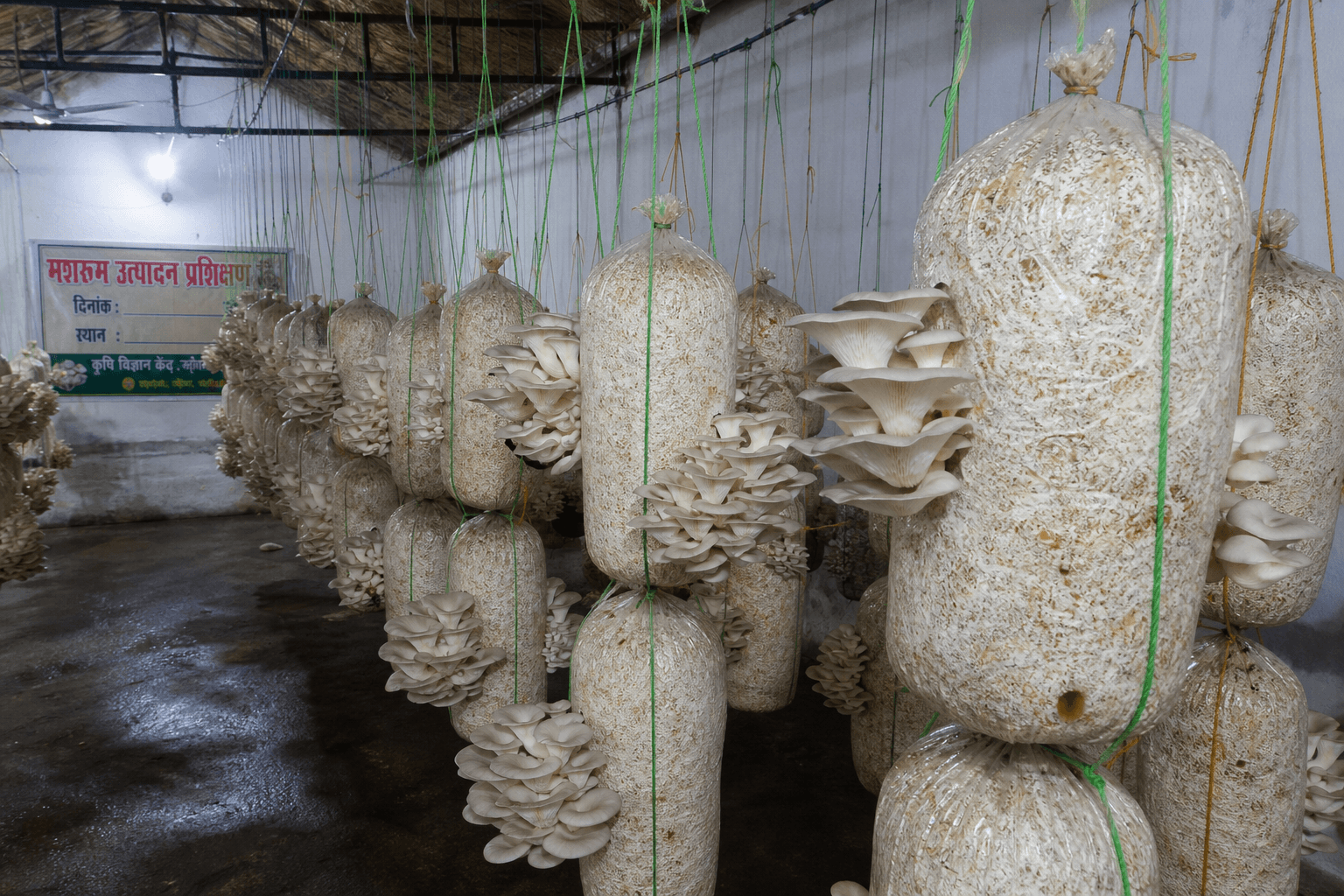
Mushroom farming is one of the few agri-businesses that fits inside a spare room, a cattle-shed corner, or a small farm building—and scales to a full commercial enterprise with bank finance and government subsidy. Unlike polyhouse capsicum, you do not need an acre of land or ₹25 lakh upfront. A 500-bag oyster mushroom unit can start at ₹50,000–₹1 lakh and produce income within weeks.
This guide covers oyster versus button mushroom economics, cycle timing, NHB and MIDH subsidies, NABARD credit linkage, value-added products, and training at ICAR-Directorate of Mushroom Research (Solan).
Why mushroom farming works as a modern kheti business
Mushrooms convert agricultural waste—paddy straw, wheat straw, sugarcane bagasse—into high-protein food sold fresh to hotels, retailers, and mandis. Demand for vegetarian protein and exotic cuisine keeps prices stable in the ₹90–100/kg range for fresh oyster mushrooms in typical markets, with value-added forms commanding far more.
Key advantages for Indian farmers:
- Small footprint — 200 sqft can hold 500 bags
- Short crop cycle — harvest weeks after inoculation, not months
- Multiple cycles per year — 6–8 cycles for oyster under managed conditions
- Subsidy support — NHB up to 50% (max ₹10 lakh on ₹20 lakh unit) plus compost subsidy
- Low land dependency — ideal for landless or small farmers, women SHGs, and side businesses
Mushroom farming sits alongside shade net nurseries and small hydroponic kits in the small farmer modern farming roadmap—low entry cost, quick cash flow, then reinvest into drip (PMKSY), protected cultivation, or scaling bag count.
Oyster vs button mushroom — choose your model
Oyster mushroom (Pleurotus) — start here
Oyster (Dhingri) is the beginner's choice. It grows across a wider temperature band, requires minimal cooling, and uses simple bag culture on pasteurised straw.
Starter unit economics (research benchmarks):
| Parameter | Figure |
|---|---|
| Unit size | 500 bags / ~200 sqft |
| Setup cost | ₹50,000–₹1 lakh |
| Yield per cycle | ~75 kg |
| Price | ₹90–100/kg |
| Cycles per year | 6–8 |
Rough revenue per cycle: 75 kg × ₹95/kg ≈ ₹7,125 gross per cycle. At 7 cycles/year, annual gross approaches ₹50,000 from a starter unit—before subtracting straw, spawn, labour, and energy. Margins improve sharply as you scale bag count and reduce per-bag wastage.
Button mushroom (Agaricus) — advanced, capital-intensive
Button mushroom needs 15–22°C cooling, composting infrastructure, and stricter hygiene. Yields can be higher per sqft in commercial setups, but electricity for climate control and compost preparation raises both capex and operating cost.
Start with oyster. Graduate to button only after you master spawn handling, sterilisation, and market contracts—and when you can fund or subsidise the ₹20 lakh-class commercial unit that NHB caps at 50% subsidy (₹10 lakh max).
Button mushroom profit depends heavily on compost quality and year-round cooling. Budget for training at ICAR-Solan or a KVK before investing in button infrastructure.
Scaling from 500 bags to commercial income
Research cites 2,000–3,000 bag units generating roughly ₹60,000–₹1.5 lakh per month when cycles run efficiently.
Scaling levers:
- Bag count — more production points, staggered inoculation for weekly harvests
- Spawn quality — certified spawn from reputed labs cuts contamination losses
- Room environment — ventilation, humidity control, clean workflows
- Buyer contracts — hotels and modern retail prefer consistent weekly supply
- Value addition — dried mushrooms (₹300–700/kg), powder, pickles extend shelf life and margins
Contamination (green mould, trichoderma) is the silent profit killer. Training and sterile technique matter more than adding bags prematurely.
Government subsidy for mushroom units
NHB (National Horticulture Board)
- Up to 50% subsidy on mushroom unit infrastructure
- Maximum ₹10 lakh on a ₹20 lakh project
- Additional 50% on compost preparation infrastructure
- Credit-linked, back-ended release after verification
- Apply at nhb.gov.in with bankable DPR and term-loan sanction
MIDH (Mission for Integrated Development of Horticulture)
- Up to 50% support under horticulture development components
- Implemented through state horticulture departments
NABARD
NABARD does not subsidise farmers directly. It refinances bank loans and passes through GoI subsidies. For mushroom projects, expect 75–90% bank finance of the project cost with a bankable DPR, similar to polyhouse and aquaponics projects.
Stack NHB/MIDH subsidy with Agriculture Infrastructure Fund (AIF) benefits where eligible: 3% interest subvention on loans up to ₹2 crore for 7 years, plus CGTMSE guarantee on loans up to ₹2 crore. See our complete government subsidy schemes list for how schemes combine without double-claiming the same component.
Subsidy is tied to approved DPR specifications and credit linkage. Building or purchasing equipment outside the sanctioned scope—or starting before approval where applicable—can disqualify your claim. Verify current NHB mushroom component guidelines on nhb.gov.in.
DPR and bank loan — what lenders expect
A bankable mushroom project DPR should include:
- Project at a glance — bags, sqft, species, cycles/year
- Promoter details — PAN, Aadhaar, training certificates
- Technical viability — spawn source, compost method, room specs, utilities
- Financial viability — DSCR ≥1.5, IRR, break-even bags, repayment schedule
- Market viability — identified buyers, transport, price assumptions
- Annexures — quotations with GST, land/lease documents, bank passbook
Collateral-free agricultural loans up to ₹2 lakh exist under standard agri-credit norms; larger mushroom units typically need secured term loans with promoter margin (10% minimum under AIF-linked projects).
Training — ICAR-Solan and KVKs
Practical training dramatically cuts first-year failure rates. Key sources:
- ICAR-Directorate of Mushroom Research, Solan (Himachal Pradesh) — national reference centre for spawn technology, compost, and disease management
- Krishi Vigyan Kendras (KVKs) — district-level hands-on courses, often affordable (₹5,000–10,000 short courses pay for themselves in avoided contamination losses)
Complete training before subsidy application so your DPR reflects realistic yield assumptions—not vendor-optimistic brochures.
Value-added products and export potential
Fresh mushrooms are perishable—24–48 hours shelf life without cold chain. Value addition stabilises income:
| Product | Price benchmark |
|---|---|
| Fresh oyster | ₹90–100/kg |
| Dried mushroom | ₹300–700/kg |
| Mushroom powder | Premium food/pharma niche |
| Pickles and snacks | Retail margin add-on |
Organic and export pathways (PKVY, NPOP, APEDA) apply if you pursue certified inputs and documented traceability—relevant if you integrate mushroom waste compost back into organic vegetable clusters.
Month-by-month business workflow
Month 1 — Training and planning
Attend ICAR-Solan or KVK course. Decide oyster vs button. Survey local hotel/retail demand.
Month 2 — Infrastructure and subsidy application
Build or retrofit growing room (cleanable walls, ventilation, shelving). Prepare DPR, bank application, and NHB/MIDH file if seeking subsidy.
Month 3 — Pilot production
Run first 100–200 bags. Document yield, contamination rate, and buyer feedback.
Months 4–6 — Scale to target bag count
Expand toward 500–2,000 bags with staggered inoculation. Introduce value-added trial batches.
Year 2 — Reinvest
Use profits for automation (humidifiers, boiler for pasteurisation), cold storage, or cross-invest into PMKSY drip on open fields.
Risks every mushroom entrepreneur should know
- Contamination — one infected bag near others spreads fast; hygiene is non-negotiable
- Spawn quality variance — unverified spawn suppliers destroy ROI
- Market glut in peak season — diversify buyers before scaling bag count
- Power cuts — button farms suffer; oyster is more forgiving but not immune
- Subsidy timing — back-ended subsidy does not replace working capital for straw and spawn purchases
- Vendor hype — treat ₹1.5 lakh/month at 3,000 bags as an upper scenario requiring disciplined operations, not a guarantee
Connecting mushroom farming to your wider modern kheti plan
Mushroom units pair well with:
- Straw availability from paddy/wheat farms on the same holding
- PMKSY drip on vegetable plots fed by spent mushroom compost
- Shade net nursery for vegetable seedlings (separate subsidy route—see our shade net house guide)
- FPO aggregation for mandi bargaining power
For farmers with limited land, mushroom farming is often the first cash-flow engine in the small and marginal farmer modern farming roadmap—months to revenue, not years.
Verification disclaimer
NHB subsidy ceilings, MIDH state shares, and mushroom component eligibility change by funding year and state. Confirm on nhb.gov.in, your state horticulture portal, and NABARD district office before signing vendor contracts.
Mushroom farming rewards technical discipline more than land size. Start with 500 oyster bags (₹50,000–₹1 lakh), target 75 kg/cycle at ₹90–100/kg across 6–8 cycles/year, scale toward 2,000–3,000 bags for ₹60,000–₹1.5 lakh/month potential, and use NHB 50% subsidy (max ₹10 lakh on ₹20 lakh) plus 50% compost support when you are ready for commercial infrastructure. Train at ICAR-Solan, keep contamination out, and sell before you scale.
Frequently asked questions
Which mushroom type is best for beginners in India?
Oyster mushroom (Dhingri) is the beginner's choice. It tolerates wider temperature ranges than button mushroom, needs less cooling infrastructure, and suits small bag-culture units starting from 500 bags.
How much does a small oyster mushroom unit cost?
A 500-bag unit covering roughly 200 sqft costs ₹50,000 to ₹1 lakh, yielding about 75 kg per cycle at ₹90–100/kg, with 6–8 cycles possible per year.
What NHB subsidy is available for mushroom farming?
NHB offers up to 50% subsidy on mushroom units, capped at ₹10 lakh on a ₹20 lakh project, plus 50% subsidy on compost preparation infrastructure.
Where can I get mushroom farming training?
ICAR-Directorate of Mushroom Research in Solan and Krishi Vigyan Kendras (KVKs) run practical training programmes for spawn handling, bag preparation, and pest management.
How much can a scaled mushroom unit earn monthly?
Units with 2,000–3,000 bags can generate roughly ₹60,000 to ₹1.5 lakh per month, depending on yield per cycle, price, and successful completion of 6–8 annual cycles.