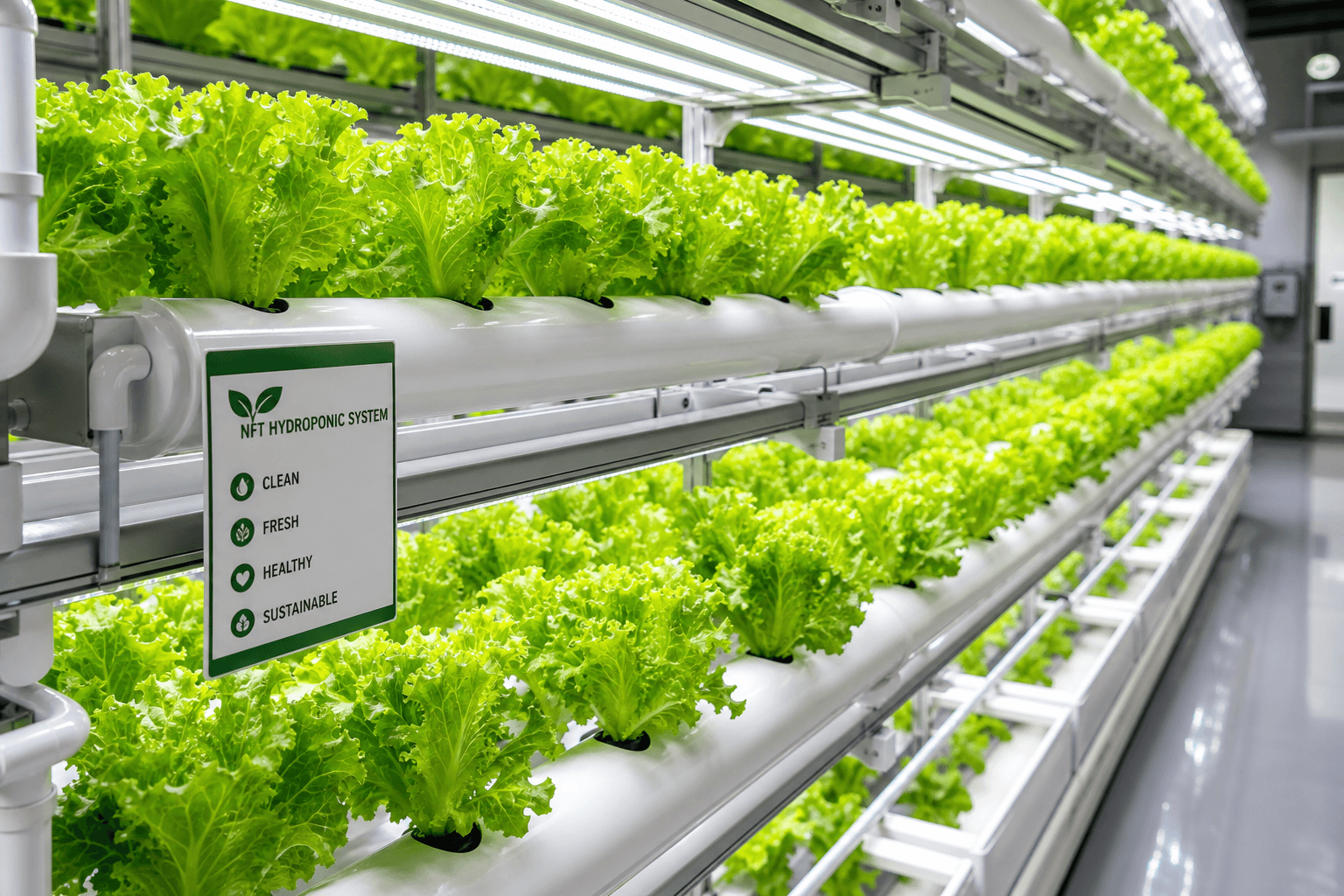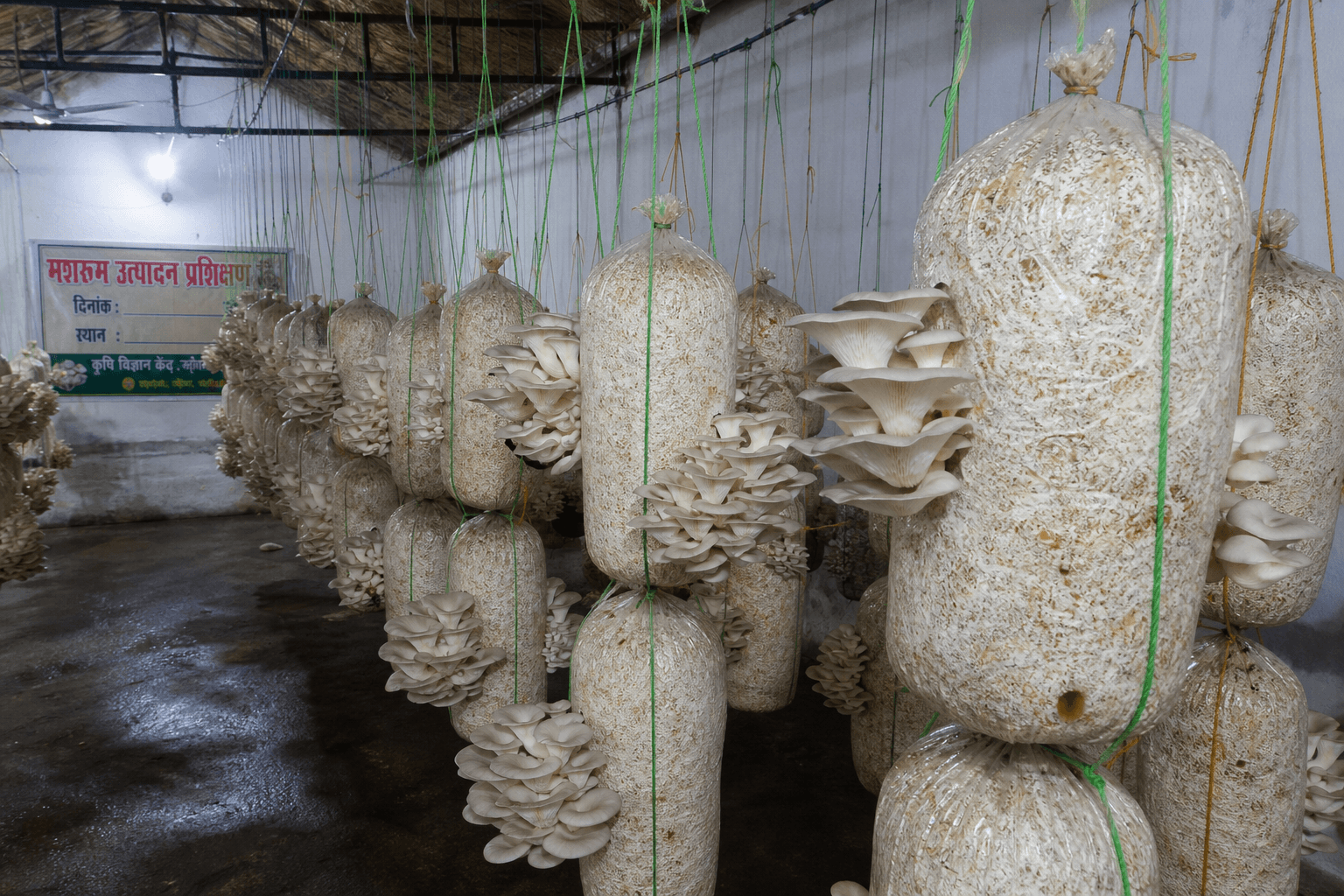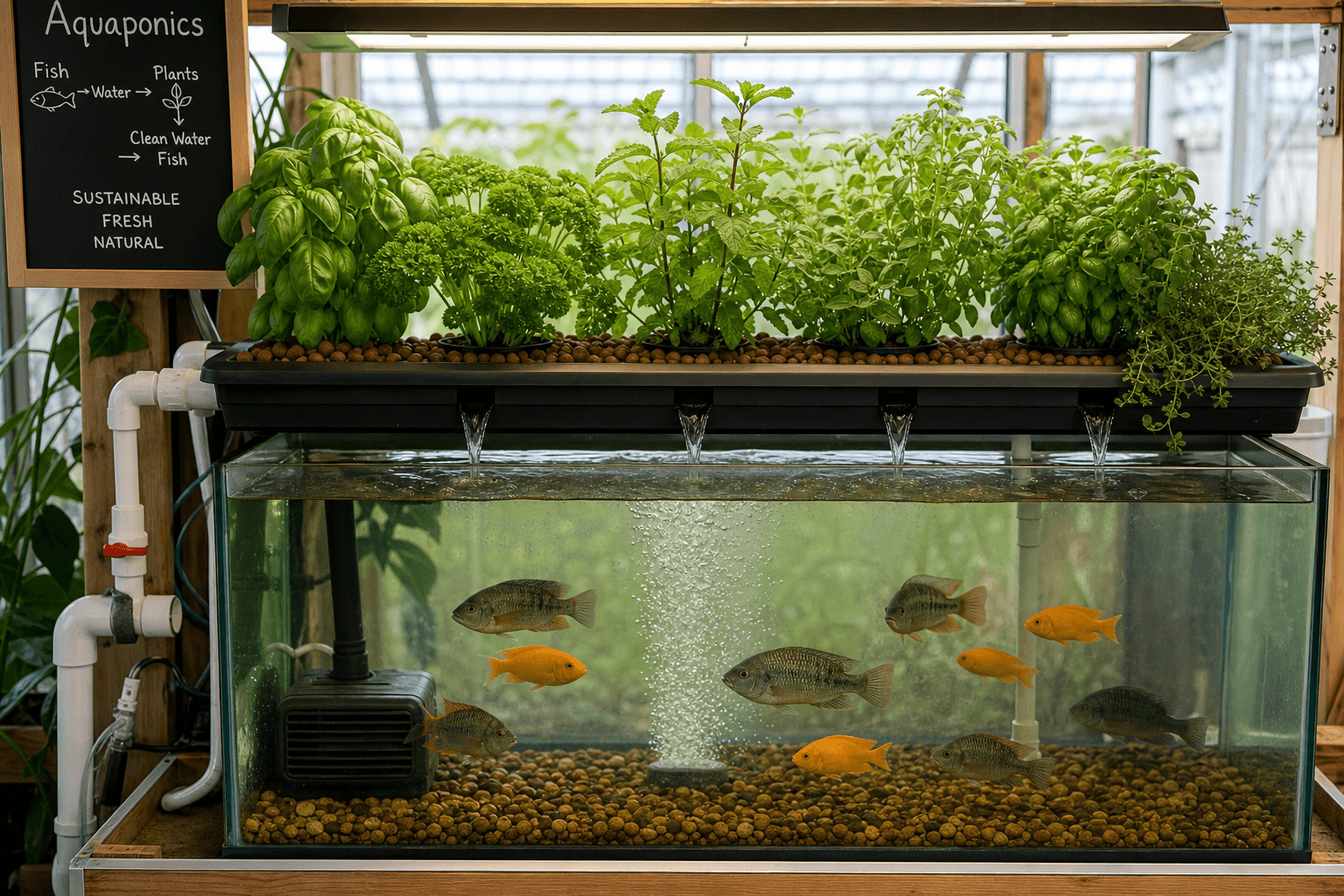
Aquaponics — growing vegetables and fish in a closed-loop water system — sits at the intersection of horticulture and fisheries. It uses approximately 90% less water than soil farming (similar to standalone hydroponics), produces two revenue streams from one unit, and fits India's push toward diversified farm income. But there is no dedicated central aquaponics subsidy. Success depends on splitting your project into fundable components, writing a bankable DPR, and understanding realistic profit ranges.
This guide covers setup costs from backyard to 1-acre commercial scale, tilapia-and-greens crop economics, how to combine PMMSY, NHB, and NABARD-refinanced bank loans, and where aquaponics fits alongside hydroponics and mushroom farming in a modern kheti portfolio.
What Aquaponics Is — and What It Is Not
In an aquaponics system, fish waste provides nutrients for hydroponically grown plants; plants filter water returned to the fish tanks. The loop replaces synthetic fertiliser with biological nutrition — attractive for organic-minded buyers and water-scarce districts.
Aquaponics is not a low-cost hobby that prints money from month one. Commercial systems require biofiltration design, dissolved oxygen management, pH balancing, backup power, and disease monitoring for both fish and crops. It is also not fully covered by a single government scheme — unlike PM-KUSUM solar pumps or PMKSY drip irrigation with clear central support rates of 55% for small/marginal farmers and 45% for others.
Treat aquaponics as an entrepreneurial project requiring split funding, similar to how mushroom units combine NHB infrastructure subsidy with NABARD credit linkage.
Setup Costs — Backyard to Commercial
Research data provides three cost tiers:
| Scale | Area / Size | Investment |
|---|---|---|
| Small / backyard | ~150 sqft | ₹60,000–65,000 |
| Mid-commercial | Variable | ₹20–50 lakh |
| 1-acre commercial | ~4,000 sqm integrated | ₹80 lakh–₹1.5 crore |
Compare this to standalone hydroponics: a 1-acre commercial hydroponics setup costs ₹70 lakh–₹1.5 crore (basic NFT/DWC kits ₹5–10 lakh; advanced systems above ₹50 lakh). Aquaponics adds fish tank infrastructure, aeration, and fisheries compliance — explaining the similar top-end range.
A shade net house (cost norm ₹710 per sqm, 50% subsidy, up to 80% for small/marginal/SC/ST in MP) can shelter a small aquaponics unit more cheaply than a full polyhouse. For year-round production of sensitive greens, a naturally ventilated polyhouse (₹25–40 lakh per acre before subsidy) or 1,000 sqm starter unit (₹7–10 lakh, falling to ₹3.5–5 lakh after subsidy) provides better climate control — fundable under NHB/MIDH with credit-linked back-ended subsidy.
There is no single "aquaponics subsidy button." Plan your DPR with separate line items for fisheries infrastructure (PMMSY/NFDB) and protected cultivation structure (NHB/NHM). Banks and inspection teams evaluate each component against its respective scheme guidelines.
Profit and Turnover — Realistic Numbers
Research provides these profit benchmarks:
- Small backyard unit: approximately ₹4 lakh per year — suitable for supplemental family income and local restaurant supply.
- Commercial 1-acre operation: ₹10–15 lakh per year turnover — not net profit; operating costs including feed, seedling, power, and labour reduce the net margin.
For context, compare with other modern methods from the same research base:
- Hydroponics 1-acre gross: ₹2–3 crore per year (upper-bound vendor scenarios; ROI 20–30% per year; break-even 3–4 years).
- Mushroom 2,000–3,000 bag unit: ₹60,000–₹1.5 lakh per month at scale.
- Polyhouse coloured capsicum: net ₹18.14 lakh per acre per year (Agrifirst NVPH data).
Aquaponics offers dual products (fish + greens) but also dual risk (fish mortality events and crop failure in the same water loop). Present turnover figures as planning estimates, not guarantees — verify market prices for tilapia and leafy greens in your district mandi before finalising your DPR crop plan.
Best Crop and Fish Combinations
Tilapia + leafy greens and herbs
Tilapia is the most common fish species in Indian aquaponics because of fast growth, tolerance to variable conditions, and strong domestic demand. Pair with:
- Lettuce — hydroponic 1-acre yields 300–400 tonnes per year versus 9–10 tonnes in soil (standalone hydroponics data).
- Basil, coriander, mint — high herb prices per kg in urban retail.
- Spinach and amaranth — fast cycling leafy crops that absorb ammonia effectively.
Higher-value hydroponic crops in integrated systems
Cherry tomato and bell pepper appear in advanced hydroponic setups (₹2–3 crore gross per acre upper-bound scenarios). In aquaponics, they demand tighter water quality control — high EC water needs treatment before use with salt-sensitive crops. Capsicum in polyhouses nets ₹18.14 lakh per acre in protected cultivation without fish integration; adding fish complexity must be justified by premium pricing or reduced fertiliser cost.
Funding Route 1 — PMMSY for Fisheries Components
The Pradhan Mantri Matsya Sampada Yojana (PMMSY) supports fisheries infrastructure:
- 40% general category financial assistance.
- 60% for SC/ST and women beneficiaries.
Aquaponics fish tanks, aeration systems, and hatchery-linked components may qualify under PMMSY or NFDB (National Fisheries Development Board) guidelines — depending on state interpretation and project classification. Apply through your state fisheries department with a fisheries-specific DPR section covering:
- Species selection and stocking density
- Water source and quality parameters
- Feed management and FCR projections
- Harvest and marketing plan
- Bio-security measures
PMMSY does not typically cover the greenhouse/hydroponic grow-bed portion — that falls under horticulture schemes.
Funding Route 2 — NHB/NHM for the Greenhouse Shell
The protected cultivation route under NHB offers:
- Flat 50% credit-linked back-ended subsidy
- Ceiling approximately ₹56 lakh per beneficiary (up to about ₹1 crore depending on structure and location)
- Minimum area 4,000 sqm general / 1,000 sqm NE-hilly
- Apply at nhb.gov.in (processing fee approximately ₹5,000–10,000)
Critical compliance rules from NHB apply fully to aquaponics greenhouses:
- Bank term-loan sanction before construction.
- Letter of Intent (LOI) or Letter of Comfort (LoC) before breaking ground — building first permanently forfeits subsidy.
- DPR must match built structure — deviating from approved crop/structure without written permission causes rejection.
- Joint Inspection Team verification (or 2023 app-based self-inspection) before subsidy credit to loan account.
Read our Polyhouse Subsidy Guide 2026 for the effective 35–40% subsidy reality when government cost norms (₹844–1,650 per sqm) lag market construction rates.
Funding Route 3 — NABARD-Refinanced Bank Loans
NABARD does not subsidise farmers directly but refinances banks that lend against bankable DPRs. For aquaponics:
- Banks may finance 75–90% of project cost through term loans.
- Your promoter contribution is typically 10% minimum (plus AIF requirements if stacking).
- DSCR ≥ 1.5 is the standard financial viability threshold banks expect.
Stack with Agriculture Infrastructure Fund (AIF) for 3% interest subvention on loans up to ₹2 crore for 7 years (portal: agriinfra.dac.gov.in). AIF is operational 2020–21 to 2032–33, requires 10% minimum promoter contribution, offers 6-month to 2-year moratorium, and is stackable with NHB/SMAM/PMKSY subsidies.
See our NABARD Loan for Farmers guide for the full bank → NABARD → subsidy pass-through workflow.
Writing a Bankable Aquaponics DPR
Your DPR must satisfy both bank credit committees and scheme nodal officers. Required sections:
Project at a glance
Scale, location, total cost, subsidy mix, implementation timeline.
Promoter details
PAN, Aadhaar, GST, caste certificate, training certificates (fisheries and horticulture short courses — ₹5,000–10,000 training pays for itself in error prevention).
Market viability
Buyer letters from restaurants, retailers, or mandi aggregators. Not pre-arranging market linkage before planting is a documented reason subsidy projects fail.
Technical viability
- Fish tank volume and species biology
- Biofilter design and B-Class GI plumbing where applicable
- UV-stabilised polyfilm of approved micron (if polyhouse)
- Water EC testing — high EC requires RO treatment before salt-sensitive crops
- Grow-bed media and planting density
- Backup aeration and power supply
- Drip/fertigation backup for crop-only periods during fish cycle changes
Financial viability
- DSCR ≥ 1.5, IRR, BCR, debt-equity ratio
- Break-even analysis and repayment schedule
- Separate revenue lines for fish and crops
- Sensitivity analysis (fish mortality at 10%, 20%, 30%)
Document checklist
Aadhaar, PAN, SC/ST certificate, land records (Jamabandi / 7-12 & 8-A / Khasra-Khatauni) or registered lease deed valid 10–15+ years (not notarised), 3–4 vendor quotations with GST, soil and water test reports, bank term-loan sanction letter, Aadhaar-linked passbook, geo-tagged construction photos.
For DPR structure details, see How to Write a DPR for Polyhouse Subsidy.
Step-by-Step Implementation Path
Phase 1 — Learn (Month 1–2)
Attend KVK or ICAR training. Visit a working aquaponics unit. Test your water source EC and pH. Compare with hydroponics farming economics to decide if fish integration adds value in your market.
Phase 2 — DPR and finance (Month 2–4)
Engage a DPR consultant familiar with split PMMSY/NHB applications. Submit to bank for term-loan sanction. Apply NHB and PMMSY before construction.
Phase 3 — Build (Month 4–8)
Construct greenhouse and tank infrastructure per approved DPR. Document every stage with geo-tagged photos. Install aeration, biofilter, and grow beds.
Phase 4 — Cycle and inspect (Month 8–12)
Stock fish at partial density; start leafy greens. Request Joint Inspection Team visit. Receive back-ended subsidy credit to loan account.
Phase 5 — Market and scale (Year 2+)
Expand restaurant contracts. Consider value-adds (filleted tilapia, mixed herb boxes) similar to mushroom value-adds (dried mushrooms ₹300–700 per kg, powder, pickles).
Risks You Must Plan For
Fish kill events — Power failure without backup aeration can wipe a tank overnight. Budget for genset or battery backup.
Water quality drift — pH and ammonia spikes harm both fish and plants. Daily monitoring is non-negotiable.
Scheme classification disputes — Some state officers classify integrated units differently. Get written clarification from both fisheries and horticulture nodal officers before construction.
Effective subsidy gap — Like polyhouse, expect 35–40% effective support, not 50% of your actual invoice. Keep 15–20% extra cash beyond margin money.
Energy costs — Similar to vertical farming where energy is up to 40% of expenses, aquaponics aeration and climate control add recurring cost. Solar pump under PM-KUSUM Component B (60% subsidy, payback under two years on diesel replacement) can offset irrigation and partial power demand.
Never start greenhouse or tank construction before bank term-loan sanction and NHB LOI/LoC. This rule applies equally to aquaponics and standard polyhouse projects — subsidy forfeiture is permanent and cannot be recovered through PMMSY or NABARD channels.
Aquaponics vs Hydroponics vs Mushroom — Quick Comparison
| Factor | Aquaponics | Hydroponics | Mushroom |
|---|---|---|---|
| Entry cost (small) | ₹60,000–65,000 | ₹5–10 lakh (basic kits) | ₹50,000–₹1 lakh (500 bags) |
| Commercial 1-acre | ₹80L–₹1.5Cr | ₹70L–₹1.5Cr | Scale to 2,000–3,000 bags |
| Dedicated subsidy | None (split funding) | None (NHB for shell) | NHB 50% max ₹10L |
| Dual revenue | Fish + crops | Crops only | Mushroom + value-adds |
| Water saving | ~90% vs soil | ~90% vs soil | Moderate |
| Key risk | Fish mortality | Energy/input cost | Climate control (button) |
The Bottom Line
Aquaponics farming in India is viable at backyard and commercial scales, with small units generating roughly ₹4 lakh per year and commercial operations turning ₹10–15 lakh annually. Fund it through PMMSY/NFDB for fisheries, NHB/NHM for the greenhouse, and NABARD-refinanced bank term loans with a bankable DPR showing DSCR ≥ 1.5. Tilapia with leafy greens remains the proven crop-fish pairing. Treat profit figures as planning estimates, comply with LOI/LoC before construction, and verify every subsidy percentage on official portals before you invest.
Disclaimer: Costs, subsidies, and scheme classifications change by state and funding window. Verify on nhb.gov.in, fisheries department portals, and your state horticulture portal before investing.
Last verified: May 2026
Frequently asked questions
How much does aquaponics cost in India?
A small backyard unit (150 sqft) costs ₹60,000–65,000. Mid-commercial setups run ₹20–50 lakh. A full 1-acre commercial aquaponics farm costs ₹80 lakh to ₹1.5 crore depending on technology level and fish stocking density.
Is there a dedicated aquaponics subsidy in India?
No dedicated central scheme exists. Funding is split — fisheries components may qualify under PMMSY (40% general / 60% for SC-ST-women) or NFDB, while the greenhouse structure may qualify under NHB/NHM protected cultivation (up to 50% credit-linked back-ended subsidy).
What is the profit from aquaponics farming?
Small backyard units generate approximately ₹4 lakh per year. Commercial 1-acre operations report ₹10–15 lakh per year turnover. Profit depends on fish species, crop mix, market access, and energy costs.
What fish and crops work best in Indian aquaponics?
Tilapia paired with leafy greens and herbs is the most common combination in Indian aquaponics projects. High-value hydroponic crops like lettuce, basil, and cherry tomato can also integrate with the system.
Can NABARD finance an aquaponics project?
Yes. NABARD refinances bank loans covering 75–90% of a bankable aquaponics project. You need a Detailed Project Report (DPR) with DSCR ≥ 1.5 and bank term-loan sanction before applying for component subsidies.