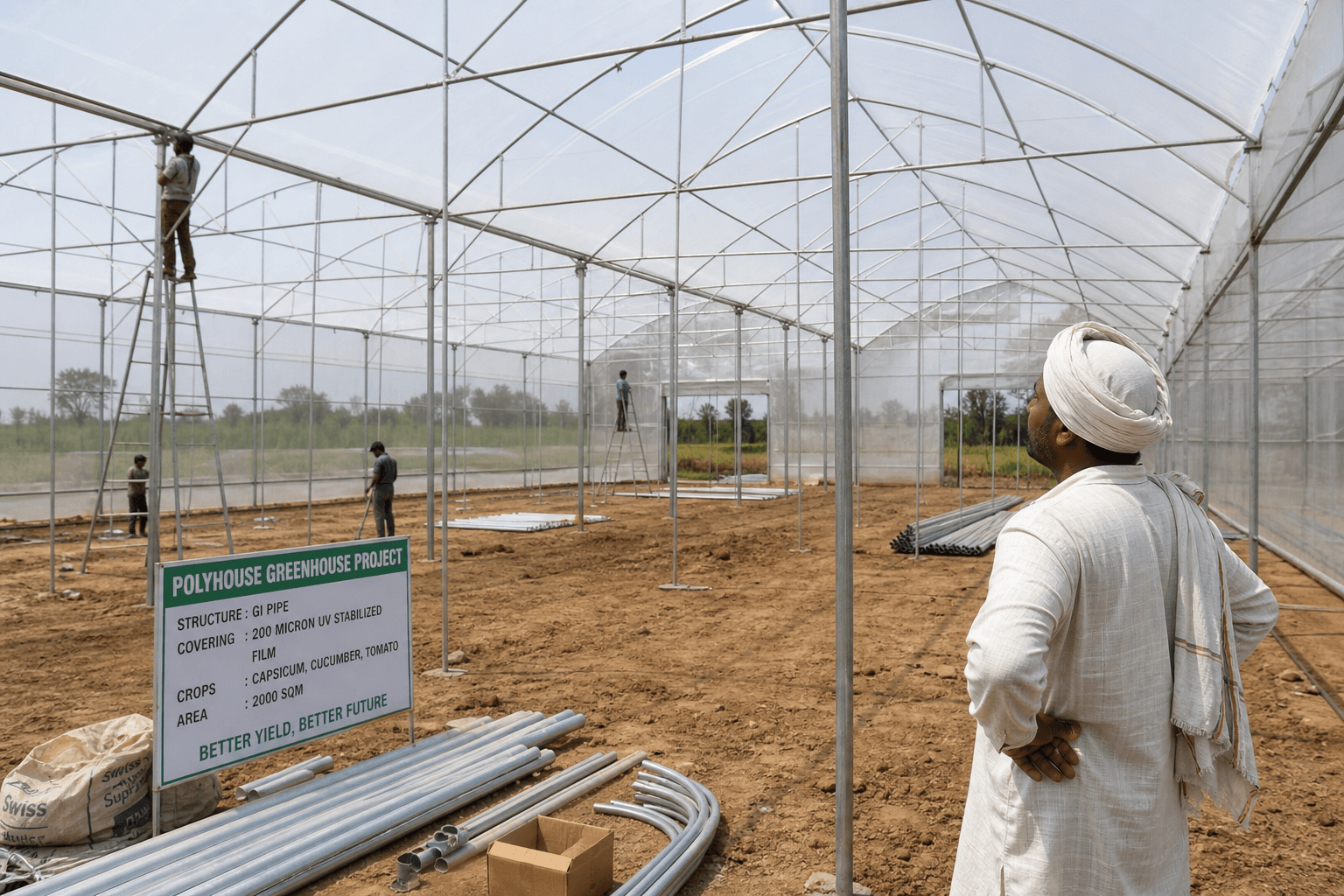
You have the land, the vendor quote, and a crop plan for coloured capsicum or seedless cucumber. The dealer says prices rise next month and urges you to "start the foundation now." Stop. If you pour a single footing before subsidy approval, you forfeit lakhs of rupees permanently.
This guide walks through every step of the polyhouse subsidy online application — from DPR preparation to bank sanction, Letter of Intent or Letter of Comfort, construction, inspection, and back-ended subsidy credit. It complements our polyhouse subsidy master guide 2026, which explains the 50% vs 35–40% effective subsidy reality and the LoI/LoC rule in depth.
Overview — Two Paths, One Golden Rule
| Route | Portal | Min area | Subsidy style |
|---|---|---|---|
| NHB commercial | nhb.gov.in | 4,000 sqm (1,000 sqm NE/hilly) | 50% back-ended, ceiling ~₹56 lakh |
| State NHM/MIDH | MahaDBT, MPFSTS, i-Khedut, etc. | Up to 4,000 sqm/beneficiary | 50% baseline + state top-ups |
Apply before you build. Every time. Secure bank term-loan sanction, submit your online application, and receive written LoI or LoC approval before construction begins. Deviation from the approved DPR crop or structure without written permission also causes automatic rejection.
Choose your route based on project size and state. Commercial 4,000 sqm (≈1 acre) NVPH projects at ₹25–40 lakh market cost typically use NHB. Smaller starters (1,000 sqm at ₹7–10 lakh) may fit state missions. Compare state rates in our state-wise polyhouse subsidy guide.
Step 1 — Training, Crop Choice, and Market Linkage
Before touching a DPR template, complete three preparatory tasks:
- Training: A ₹5,000–10,000 short course at a KVK, SAU, or private horticulture academy pays for itself. Protected cultivation is unforgiving of amateur mistakes.
- Crop choice: Match crop to structure. Coloured capsicum (~₹18.14 lakh net/acre/year), seedless cucumber (~₹16.76 lakh), gerbera, Dutch rose — not bulk spinach or okra. See best high-profit polyhouse crops.
- Market linkage: Pre-arrange mandi, exporter, or contract buyer. Mistake six on our failure list is planting without a buyer.
Step 2 — Land, Water, and Vendor Quotations
Land documents
Submit one of:
- Ownership records: Jamabandi, 7-12 & 8-A (Maharashtra), Khasra-Khatauni — per state format
- Lease: Registered lease deed valid 10–15+ years — not merely notarised
Karnataka MIDH requires land ≥2× polyhouse area. Haryana offers self-install options on HORTNET. Check state-specific land rules before paying a vendor advance.
Water and soil tests
Collect soil and water test reports. High electrical conductivity (EC) blocks capsicum and gerbera until you install RO treatment — a common hidden cost omitted from vendor quotes.
Vendor quotations
Obtain 3–4 quotations with GST from empaneled or recognised erectors. Specs must match NHB technical norms:
- B-Class GI pipes
- UV-stabilised polyfilm of approved micron thickness
- Drip/fertigation integration (also eligible under PMKSY separately)
- Ventilation appropriate to NVPH vs fan-and-pad hi-tech (₹1,400–1,650/sqm norm)
Step 3 — Write the Bankable DPR
The Detailed Project Report is the spine of your application. Banks and NHB reject vague DPRs daily.
Required DPR sections
- Project at a glance — location, area, structure type, crop, cost summary
- Promoter details — PAN, Aadhaar, GST, caste certificate, training certificates
- Disclosure of benefits already availed — prevents double-claiming
- Market viability — demand, prices, off-take agreements
- Technical viability — structure specs, water EC, crop calendar, yield assumptions
- Financial viability — DSCR ≥1.5, IRR, BCR, debt-equity, break-even, repayment with moratorium
- Crop plan — yield and price projections aligned with research benchmarks
- Employment generation
- Annexures — quotations, maps, certificates
Financial ratios matter. A project showing DSCR below 1.5 will not receive bank sanction. Use conservative price assumptions — capsicum ₹75–150/kg (highest Oct–Dec when supply is tight), cucumber harvest from ~35 days with 2–3 cycles/year.
Deep dive: how to write a DPR for polyhouse subsidy.
Step 4 — Bank Term-Loan Sanction
NHB subsidy is credit-linked. You need a term-loan sanction letter from a commercial bank, cooperative bank, or RRB before NHB accepts your application.
Stack affordable debt:
- Agriculture Infrastructure Fund: 3% interest subvention on loans up to ₹2 crore for 7 years — stackable with NHB (agriinfra.dac.gov.in)
- NABARD refinance to your bank — NABARD farmer loan process
- Promoter contribution: typically 10% minimum under AIF; banks may require more
Budget 15–20% extra cash beyond margin. Government cost norms (₹844–1,650/sqm) lag market prices, so effective subsidy is 35–40% of actual spend — not the advertised 50%. Your loan should cover the gap.
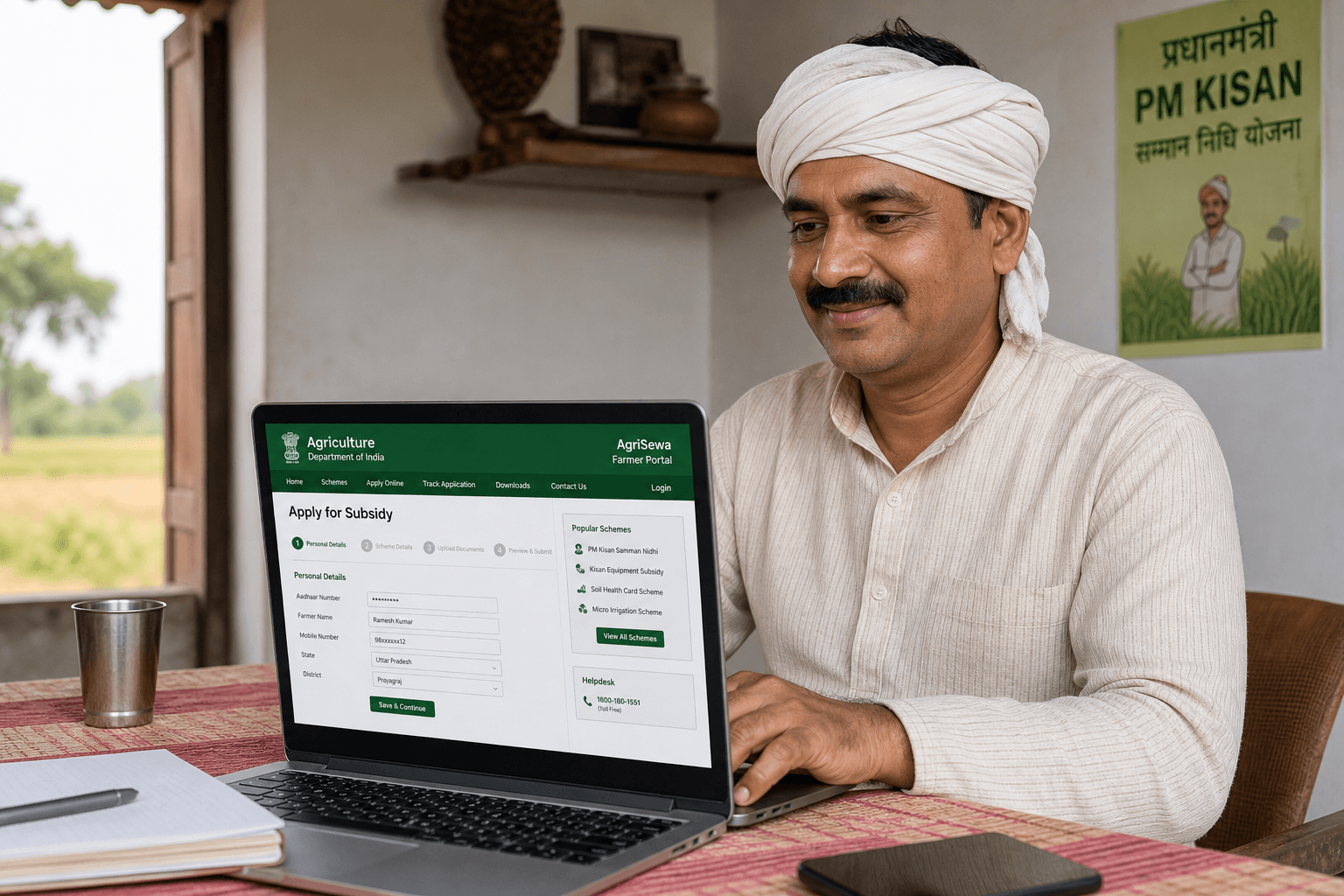
Step 5 — Online Registration and Application
NHB route (nhb.gov.in)
- Create account on nhb.gov.in
- Select scheme — commercial horticulture / protected cultivation
- Upload DPR and annexures
- Enter bank sanction details — loan amount, interest rate, moratorium
- Pay processing fee — approximately ₹5,000–10,000
- Submit and note application reference number
- Track status on portal dashboard
Minimum area: 4,000 sqm general states; 1,000 sqm NE and hilly. Subsidy ceiling: roughly ₹56 lakh (up to about ₹1 crore depending on structure/location).
State NHM/MIDH route
Each state portal differs:
| State | Portal | Method |
|---|---|---|
| Maharashtra | mahadbt.maharashtra.gov.in | Computerized lottery; needs 7/12 & 8A |
| Madhya Pradesh | mpfsts.mp.gov.in | Online; apply Apr–Jun for speed |
| Gujarat | ikhedut.gujarat.gov.in | First-come-first-served |
| Telangana | horticulture.tg.nic.in | 75% general; 95% SC/ST |
| Rajasthan | RajKisan | Lottery; 1–2 windows/year |
| Uttar Pradesh | uphorticulture.gov.in | Online + DHO verification |
Upload the same core documents: Aadhaar, land records, quotations, bank papers, caste certificate if claiming enhanced SC/ST rates.
Step 6 — Letter of Intent or Letter of Comfort
After scrutiny, NHB or the state department issues written approval.
Legacy flow (still cited in many 2026 guides)
- In-Principle Approval (IPA) → Grant of Clearance (GoC) → Letter of Intent (LoI)
- Construct after LoI
- Joint Inspection Team (JIT) visits post-construction
2023 simplified NHB flow
- Optional Letter of Comfort (LoC) replaces much of the two-stage process
- Mobile-app self-inspection may substitute for physical JIT in eligible cases (PIB PRID 1906941)
You may begin construction only after receiving LoI or LoC in writing. Verbal assurances from dealers or local agents do not count.
If your approval letter specifies conditions — approved crop, structure type, maximum cost — follow them exactly. Changing from capsicum to cucumber without written permission is grounds for rejection.
Step 7 — Construction to Approved Specifications
Build precisely as per DPR:
| Element | Requirement |
|---|---|
| Structure type | NVPH vs fan-and-pad vs shade net (₹710/sqm norm) |
| Area | Match approved sqm slab — subsidy norms differ by slab up to 4,000 sqm |
| Materials | B-Class GI, approved polyfilm micron, UV stabilisation |
| Crop | Plant approved crop; book certified tissue-culture/pro-tray seedlings 3–4 months ahead |
| Irrigation | Drip/fertigation per DPR; PMKSY may subsidise separately |
Take geo-tagged photographs at foundation, frame erection, polyfilm covering, and planting stages. These photos support inspection and dispute resolution.
Running costs after Year 1: ₹4–6 lakh/year for a 4,000 sqm unit. Net profit target: ₹6–14 lakh/year with payback in 2–4 years on well-managed projects.
Step 8 — Inspection and Subsidy Credit
Joint Inspection Team (JIT)
Inspectors verify:
- Built area and height match DPR and approval letter
- Materials match specifications
- Crop matches approved crop plan
- Location matches land records and geo-tags
Failure triggers partial subsidy reduction or full rejection depending on deviation severity.
Mobile-app self-inspection (NHB 2023 reform)
Eligible applicants submit inspection data via NHB mobile app. Confirm whether your LoC mandates app inspection, physical JIT, or both.
Back-ended subsidy credit
Upon clearance, 50% of eligible cost (subject to ceiling and cost norms) credits to your loan account, reducing outstanding principal. Because norms cap eligible cost below market quotes, expect 35–40% effective relief on total project spend — the central message of our polyhouse subsidy pillar guide.
Step 9 — Post-Subsidy Operations and Re-Application
From Year 2, focus on:
- Running cost control — labour, inputs, energy
- Market timing — capsicum prices peak Oct–Dec
- Crop cycles — cucumber 2–3 cycles/year
- Scheme stacking — PM-KUSUM solar pump, SMAM drone for monitoring
You cannot re-apply NHB subsidy on the same structure, but additional land or a second beneficiary in the family may qualify separately. PMKSY drip re-applies on the same land after 7 years.
Document Checklist — Print and Tick
- Aadhaar card
- PAN card
- SC/ST caste certificate (if enhanced category)
- Land ownership OR registered lease 10–15+ years
- Jamabandi / 7-12 / 8-A / Khasra-Khatauni
- 3–4 vendor quotations with GST
- Soil test report
- Water test report (note EC)
- Bank term-loan sanction letter
- Aadhaar-linked bank passbook
- DPR with DSCR ≥1.5
- Training certificate (recommended)
- Market linkage proof (recommended)
- Geo-tagged construction photos (after approval)
Timelines and Practical Tips
Madhya Pradesh: Apply April–June on MPFSTS for faster lottery results.
Maharashtra: MahaDBT lottery — no shortcut; submit complete files before deadline.
Gujarat: i-Khedut first-come-first-served — early submission wins.
Telangana: Among India's highest rates (95% SC/ST) — high demand, strict verification.
Allow 3–6 months from DPR to LoC in typical cases. Construction adds 2–4 months. Inspection and subsidy credit add 1–3 months. Total project timeline: 9–14 months from zero to subsidy in bank — plan cash flow accordingly.
Mistakes That Kill Applications
Cross-reference our 9 mistakes guide:
- Construction before LoI/LoC
- Trusting 50% headline without norm-adjusted maths
- Low-value crops in high-cost structures
- Roadside nursery plants instead of certified seedlings
- Skipping training
- No buyer before planting
- DPR deviation without permission
- Wrong drone brand for SMAM (non-DGCA illegal)
- Ignoring water EC
Where to Get Help
- NHB: nhb.gov.in — scheme circulars and application portal
- State horticulture department — district horticulture officer (DHO)
- Bank agriculture branch — loan sanction and AIF subvention
- KVK / ICAR — training and soil/water testing referrals
- Modern Kheti guides: complete subsidy list 2026, polyhouse profit and cost
Final Reminder
The online application is not bureaucracy for its own sake. It protects public money and separates serious entrepreneurs from speculative builders. Follow the sequence — DPR → bank sanction → online apply → LoI/LoC → build → inspect → subsidy — and you join the farmers earning ₹6–18 lakh per acre from protected cultivation with government support that actually arrives.
Verify every fee, deadline, and percentage on nhb.gov.in and your state .gov.in portal before you submit. When in doubt, wait for written approval. The polyhouse will still be there next month; the subsidy will not be there if you build too early.
Frequently asked questions
What is the first step to apply for polyhouse subsidy online?
Prepare a bankable Detailed Project Report (DPR) and secure bank term-loan sanction before any construction. Then register on nhb.gov.in for the NHB commercial route, or on your state horticulture portal (MahaDBT, MPFSTS, i-Khedut, etc.) for NHM/MIDH — and submit the application before building starts.
How much is the NHB online application processing fee?
The NHB processing fee is roughly ₹5,000 to ₹10,000 depending on project type. Verify the current fee on nhb.gov.in when you apply, as it may be updated.
What documents are required for polyhouse subsidy application?
Aadhaar, PAN, SC/ST certificate if applicable, land records or registered lease deed valid 10–15+ years, 3–4 vendor quotations with GST, soil and water test reports, bank term-loan sanction letter, Aadhaar-linked passbook, and geo-tagged construction photos after building.
What happens after I receive Letter of Comfort from NHB?
You may begin construction strictly as per the approved DPR. After completion, undergo Joint Inspection Team verification or NHB mobile-app self-inspection (2023 reform). Back-ended subsidy is then credited to your loan account — typically 50% of eligible cost subject to ceiling, which effectively works out to 35–40% of actual market spend for many farmers.
Can I apply for state MIDH subsidy and NHB subsidy for the same polyhouse?
You cannot double-claim the same component on the same structure. Choose the route that fits your area (minimum 4,000 sqm for NHB general; 1,000 sqm NE/hilly) and category. Disclose benefits already availed in your DPR. Verify stacking rules on official portals before submitting.